More Fun with Hexa-Trex

Hexa-trex turtle logo

My elementary Math Club students had fun practicing their math facts and “out of the box” thinking with Hexa-Trex puzzles. The object of Hexa-Trex is to find a path through all the number and operation tiles to make a true equation. The “Easy” puzzles are just the right level for my 4th-5th grade students, although they get stumped whenever the equations require Order of Operations. One girl enjoyed the puzzles enough to take our extra pages home for her dad.

Hexa-Trex puzzles were featured in the October issue of Games magazine, and now you can enjoy Hexa-Trex away from the computer with Bogusia Gierus‘s new book, The First Book of Hexa-Trex Puzzles. If you are thinking ahead to Christmas (can it be that time already?!), and if you have a puzzle lover in the family, this little book would make a fun stocking-stuffer.

Quiz: Those Frustrating Fractions

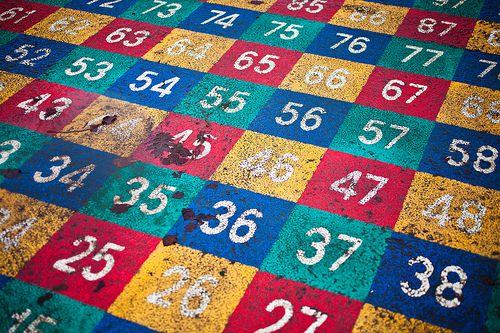
[Photo by jimmiehomeschoolmom.]

Fractions confuse almost everybody. In fact, fractions probably cause more math phobia among children (and their parents) than any other topic before algebra. Middle school textbooks devote a tremendous number of pages to teaching fractions, and still many students find fractions impossible to understand. Standardized tests are stacked with fraction questions.

Fractions are a filter, separating the math haves from the luckless have nots. One major source of difficulty with fractions is that the rules do not seem to make sense. Can you explain these to your children?

Start with an easy one…

Question #1

If you need a common denominator to add or subtract fractions…

  • Why don’t you need a common denominator when you multiply?

Continue reading Quiz: Those Frustrating Fractions

Ben Franklin Math: Elementary Problem Solving 3rd Grade

The ability to solve word problems ranks high on any math teacher’s list of goals. How can I teach my students to solve math problems? I must help them develop the ability to translate “real world” situations into mathematical language.

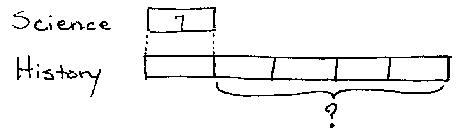
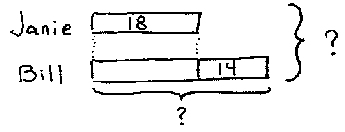
In two previous posts, I introduced the problem-solving tools algebra and bar diagrams. These tools help our students organize the information in a word problem and translate it into a mathematical calculation.
Working Math Problems with Poor Richard

This time I will demonstrate these problem-solving tools in action with a series of 3rd-grade problems based on the Singapore Primary Math series, level 3A. For your reading pleasure, I have translated the problems into the life of Ben Franklin, inspired by the biography Poor Richard by James Daugherty.

Continue reading Ben Franklin Math: Elementary Problem Solving 3rd Grade

Penguin Math: Elementary Problem Solving 2nd Grade

The ability to solve word problems ranks high on any math teacher’s list of goals. How can I teach my students to reason their way through math problems? I must help my students develop the ability to translate “real world” situations into mathematical language.

In a previous post, I analyzed two problem-solving tools we can teach our students: algebra and bar diagrams. These tools help our students organize the information in a word problem and translate it into a mathematical calculation.

Now I want to demonstrate these problem-solving tools in action with a series of 2nd grade problems, based on the Singapore Primary Math series, level 2A. For your reading pleasure, I have translated the problems into the universe of one of our family’s favorite read-aloud books, Mr. Popper’s Penguins.

UPDATE: Problems have been genericized to avoid copyright issues.

Continue reading Penguin Math: Elementary Problem Solving 2nd Grade
Egyptian Math: The Answers

Remember the Math Adventurer’s Rule: Figure it out for yourself! Whenever I give a problem in an Alexandria Jones story, I will try to post the answer soon afterward. But don’t peek! If I tell you the answer, you miss out on the fun of solving the puzzle. So if you haven’t worked these problems yet, go back to the original posts. Figure them out for yourself—and then check the answers just to prove that you got them right.

Continue reading Egyptian Math: The Answers

Another Egyptian Math Puzzle

Pyramids clip artI have one last puzzle for those of you who are following my Alexandria Jones series on hieroglyphic math and the Egyptian scribe’s method of multiplication by doubling. Here is the “teaser” problem from the cover of the Sept./Oct.1998 issue of my newsletter:

One more Egyptian math puzzle (pdf, 53KB)

Continue reading Another Egyptian Math Puzzle

7 Things to Do with a Hundred Chart


This post has been revised to incorporate all the suggestions in the comments below, plus many more activities. Please update your bookmarks:

Or continue reading the original article…


Continue reading 7 Things to Do with a Hundred Chart

Alex’s Puzzling Papyrus

(In the last episode, Dr. Fibonacci Jones discovered a torn scrap of papyrus, covered with hieroglyphic numbers. He promised to teach his daughter, Alexandria, how the ancient Egyptian scribes worked multiplication problems using only the times-two table.)

Back at their tent, Dr. Jones handed the papyrus scrap to Alexandria. “What do you see?” he asked.

“Well, there are two columns of numbers,” Alex said. “Let me write them down.” She got a piece of notebook paper and translated the hieroglyphs. Papyrus fragment

Click on the image for a larger view. Translate the numbers for yourself before reading on. If you need help, read Egyptian Math in Hieroglyphs.

Continue reading Alex’s Puzzling Papyrus

Math Jokes

Blame it on MathNotations and his Corny Math Jokes (which actually included one I hadn’t heard before) — or maybe I have been reading too many of Chickenfoot’s strange tales — but anyway, I’m in a mood for humor.

So here are a couple of old favorites:

Eric W. Weisstein
from MathWorld–A Wolfram Web Resource

Hat tip: These had gotten lost in the dustbunnies of my memory until I saw the Frivolous Theorem mentioned recently at Art of Problem Solving.

Edited to add: Scott at Grey Matters recently updated his Mathematical Humor post, which may be where I had originally read these. He links to several more great MathWorld jokes, including the ever-tasty Pizza Theorem.