I was going to blog about the new Playful Math Education Carnival, but I ran out of time. Tomorrow, then.
Meanwhile, here’s a Christmas cat picture.
Best wishes for a merry season!

I was going to blog about the new Playful Math Education Carnival, but I ran out of time. Tomorrow, then.
Meanwhile, here’s a Christmas cat picture.
Best wishes for a merry season!
Did your device hide the video? Find it on YouTube here.
For the promise to Abraham and his offspring that he would be heir of the world did not come through the law but through the righteousness of faith.
For if it is the adherents of the law who are to be the heirs, faith is null and the promise is void.
That is why it depends on faith, in order that the promise may rest on grace and be guaranteed to all his offspring — not only to the adherent of the law but also to the one who shares the faith of Abraham, who is the father of us all — in the presence of the God in whom he believed, who gives life to the dead and calls into existence the things that do not exist.
In hope he believed against hope, that he should become the father of many nations … That is why his faith was “counted to him as righteousness.”
But the words “it was counted to him” were not written for his sake alone, but for ours also.
It will be counted to us who believe in him who raised from the dead Jesus our Lord, who was delivered up for our trespasses and raised for our justification.
Scripture quotations are from the ESV® Bible (The Holy Bible, English Standard Version®), copyright © 2001 by Crossway, a publishing ministry of Good News Publishers. Used by permission. All rights reserved. ESV.org.

Enjoy this bit of seasonal fidgeting from Vi Hart.
If you don’t understand some of the references, that’s normal! Pick a phrase, Google it, and relish the fun of learning something new.
Did your device hide the video? Find it on YouTube here.
CREDITS: Lamppost photo (top) by Aaron Burden via Unsplash.com.
Would you like to add some no-preparation-required fun to your math lessons this month?
Check out these creative mathematical Advent calendars, each featuring one puzzle or activity per day for December 1–24.
Some of the calendars may show a previous year’s date. (This is 2020 after all!) But the puzzles are evergreen — you can enjoy them anytime.
For more Advent-math links, visit Colleen Young’s Mathematical Advent Calendars post. And don’t miss my massive blog post Holiday Math Puzzles and Activities for Christmas, Winter Break.
Did your device hide the video? Find it on YouTube here.
For while we were still weak, at the right time Christ died for the ungodly.
For one will scarcely die for a righteous person — though perhaps for a good person one would dare even to die — but God shows his love for us in that while we were still sinners, Christ died for us.
Since, therefore, we have now been justified by his blood, much more shall we be saved by him from the wrath of God.
For if while we were enemies we were reconciled to God by the death of his Son, much more, now that we are reconciled, shall we be saved by his life.
More than that, we also rejoice in God through our Lord Jesus Christ, through whom we have now received reconciliation.
Scripture quotations are from the ESV® Bible (The Holy Bible, English Standard Version®), copyright © 2001 by Crossway, a publishing ministry of Good News Publishers. Used by permission. All rights reserved. ESV.org.
Today, we celebrate the traditional beginning of the Christmas music season…
Did your device hide the video? Find it on YouTube here.
There shall come forth a shoot from the stump of Jesse,
and a branch from his roots shall bear fruit.
And the Spirit of the Lord shall rest upon him,
the Spirit of wisdom and understanding,
the Spirit of counsel and might,
the Spirit of knowledge and the fear of the Lord.
And his delight shall be in the fear of the Lord.
he shall not judge by what his eyes see,
or decide disputes by what his ears hear,
but with righteousness he shall judge the poor,
and decide with equity for the meek of the earth.
… They shall not hurt or destroy
in all my holy mountain;
for the earth shall be full of the knowledge of the Lord
as the waters cover the sea.
In that day the root of Jesse shall stand as a signal for the peoples — of him shall the nations inquire, and his resting place shall be glorious.
Scripture quotations are from the ESV® Bible (The Holy Bible, English Standard Version®), copyright © 2001 by Crossway, a publishing ministry of Good News Publishers. Used by permission. All rights reserved. ESV.org.


Do you know of any great math-related seasonal games, crafts, or activities I missed? Please add them to the comments section below.
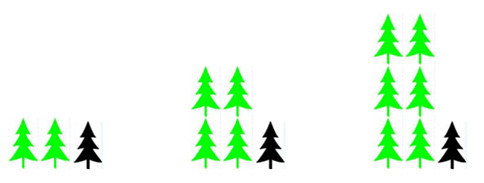
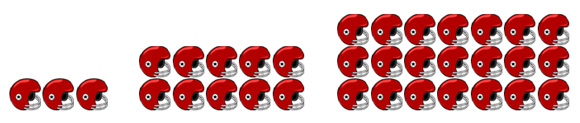
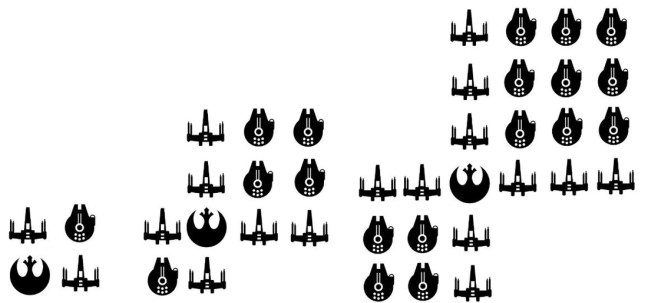
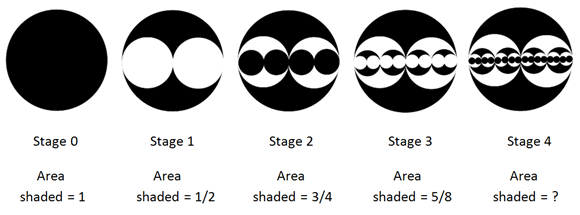
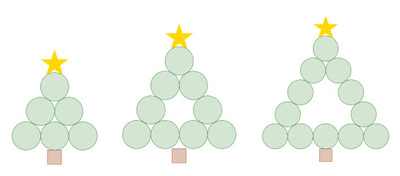
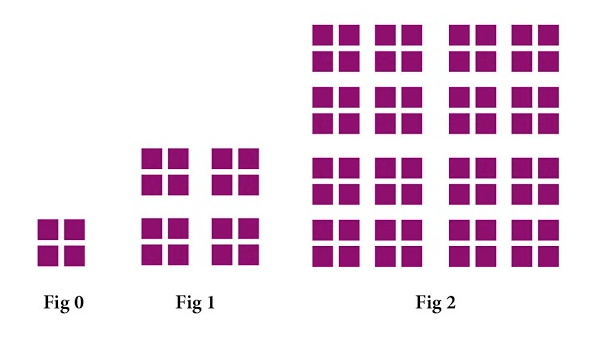
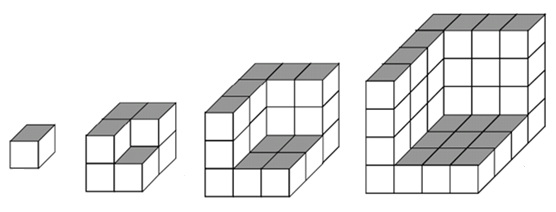
As you scroll through the links below, you find several puzzle graphics from the wonderful Visual Patterns website.
Use them as conversation-starters with your kids: What do you notice? How does each pattern grow?
For older students: Can you write a formula to describe how each pattern? What will it look at stage 43?
Setting the mood: Enjoy this bit of seasonal fidgeting from Vi Hart. If you don’t understand some of the references, that’s normal! Pick a phrase, Google it, and enjoy the fun of learning something new.
Every year, some of my favorite websites offer a seasonal selection of activities to encourage your children’s (and your own!) mathematical creativity, one for each day in the run-up to Christmas.
Colleen Young updates the list every year, so check out her pages:





Alexandria Jones and her family are fictional characters from my old Mathematical Adventures newsletter. Their stories appear sporadically as I find time to transcribe them from the back-issues. You can find them all on this blog page.
Here are all the Alexandria Jones stories Christmas stories, with activity and craft ideas…
Do you need to keep your kids busy and work in a bit of math practice? Try these Christmas word problems:
Or visit the sites below for worksheets to cover all ages:
CREDITS: “Circle Packing” feature graphic (top) by fdecomite via Flickr (CC BY 2.0). Picture pattern puzzles from Visual Patterns website.
Do you enjoy math? I hope so! If not, the links in this post just may change your mind.
Welcome to the 114th edition of the Math Teachers At Play math education blog carnival — a smorgasbord of articles by bloggers all around the internet who have great ideas for learning, teaching, and playing around with math from preschool to pre-college.
If you would like to jump straight to our featured blog posts, click here to see the Table of Contents.
By the way, I found a cool, semi-self-referential trivia tidbit about our carnival number: 27 − 14 = 114. And if you put 114 dots into a 1←7 Exploding Dots machine, you’ll get the code 222. Pretty neat!
As you scroll through the links below, you find several puzzle graphics from the wonderful Visual Patterns website. Use them as conversation-starters with your kids: What do you notice? How does each pattern grow? For older students: Can you write a formula to describe how each pattern? What will it look at stage 43?
Setting the mood: Enjoy this bit of seasonal fidgeting from Vi Hart (@vihartvihart).
If you don’t understand some of the references, that’s normal! Pick a phrase, Google it, and enjoy the fun of learning something new.
And now, on to the main attraction: the blog posts. Some articles were submitted by their authors; others were drawn from the immense backlog in my rss reader. If you’d like to skip directly to your area of interest, click one of these links.
Let the mathematical fun begin!
Continue reading Holiday Math and More: Playful Math Education Carnival 114
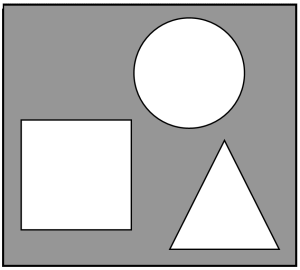 For toddler Renée’s Christmas gift, Alex and Leon crafted a puzzle set of wooden blocks.
First, they made a sturdy box with circle, square, and triangle shapes cut in the lid.
To make the blocks large and baby-safe, Alex and Leon bought a 4-foot 2×2 board. Then they asked Uncle Will to help them create a set of special blocks to fit through the holes.
Each block was round and square and triangular, so it could fit exactly through any of the three holes.
How can that be?
Read all the posts from the December 2000/January 2001 issue of my Mathematical Adventures of Alexandria Jones newsletter.
CREDITS: “Christmas Tree Closeup” photo by Zechariah Judy via Flickr (CC BY 2.0).

To make a Christmas gift for her brother Leon, Alex asked all her friends to save empty cereal boxes. She collected about a dozen boxes.
She cut the boxes open, which gave her several big sheets of thin cardboard.
Then she carefully traced the templates for a regular triangle, square, pentagon, and hexagon, as shown below.

Click here to download the polygon templates
She drew the dark outline of each polygon with a ballpoint pen, pressing hard to score the cardboard so the tabs would bend easily.
She cut out shapes until her fingers felt bruised: 20 each of the pentagon and hexagon, 40 each of the triangle and square.
Alex bought a bag of small rubber bands for holding the tabs together. Each rubber band can hold two tabs, forming an edge of the polyhedron. So, for instance, it takes six squares and twelve rubber bands to make a cube.
Finally, she stuffed the whole kit in a plastic zipper bag, along with the following instructions.
Poly means many, and hedron means face, so a polyhedron is a 3-D shape with many faces.
The plural of polyhedron is polyhedra, thanks to the ancient Greeks, who didn’t know that the proper way to make a plural was to use the letter s.
Each corner of a polyhedron is called a vertex, and to make it more confusing, the plural of vertex is vertices.
Regular polyhedra have exactly the same faces and corners all around. If one side is a square, then all the sides will be squares. And if three squares meet to make one vertex, then all the other vertices will be made of three squares, just like that first one.
There are only five possible regular polyhedra. Can you figure out why?
Here are the five regular polyhedra, also called the Platonic solids. Try to build each of them with your construction kit.
Tetrahedron: three equilateral triangles meeting at each vertex.
Hexahedron: three squares meeting at each vertex. Do you know its common name?
Octahedron: four triangles at each vertex.
Icosahedron: five triangles at each vertex.
Dodecahedron: three pentagons per vertex.
You can find pictures of these online, but it’s more challenging to build them without peeking at the finished product. Just repeat the vertex pattern at every corner until the polygons connect together to make a complete 3-D shape.
Semi-regular polyhedra have each face a regular polygon, although not all the same. Each corner is still the same all around. These are often called the Archimedean polyhedra.
For example, on the cuboctahedron, every vertex consists of a square-triangle-square-triangle combination.
Here are a few semi-regular polyhedra you might try to build, described by the faces in the order they meet at each corner:
Icosidodecahedron: triangle, pentagon, triangle, pentagon.
Truncated octahedron: square, hexagon, hexagon.
Truncated icosahedron: pentagon, hexagon, hexagon. Where have you seen this?
Rhombicuboctahedron: triangle, square, square, square.
Rhombicosidodecahedron: triangle, square, pentagon, square.
Now, make up some original polyhedra of your own. What will you name them?
Read all the posts from the December 2000/January 2001 issue of my Mathematical Adventures of Alexandria Jones newsletter.
CREDITS: “50/52 Weeks of Teddy – Merry Christmas” photo by Austin Kirk via Flickr (CC BY 2.0).
 Denise Gaskins' Let's Play Math