Happy Square Root Day!

square-roots-by-arsheffield
[Photo by arsheffield.]

Check it out:

And coming soon: Pi Day.

Edited to add: Jonathan‘s class enjoyed extending the concept to include other products. Using the m/d/yy format (not the 4-digit year), how many times in your life has it been true that month \times day = year ?

Math Teachers at Play #1

[Photo by StuSeeger.]

Welcome to the inaugural edition of the Math Teachers At Play blog carnival! I hope you enjoy this collection of tips, tidbits, games, and activities for students and teachers of preschool-12th grade mathematics.

For this first carnival, I’ve drawn several recent posts from my blog reader as examples of the types of posts I’d love to include in future editions of Math Teachers at Play. I tried to find something for everyone, from multiplication drill for elementary students to advice for understanding high school math equations.

Let the mathematical fun begin…

Continue reading Math Teachers at Play #1

A Mathematician for President

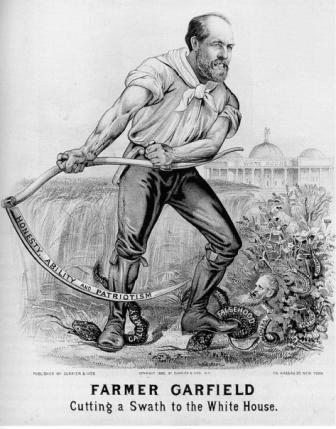
In 1876, a politician made mathematical history. James Abram Garfield, the honorable Congressman from Ohio, published a brand new proof of the Pythagorean Theorem in The New England Journal of Education. He concluded, “We think it something on which the members of both houses can unite without distinction of party.”

Continue reading A Mathematician for President

Online Game: Math Caching

In the treasure-hunting game of Geocaching (pronounced “geo-cashing”), players use GPS systems to locate boxes hidden at different geographical locations across the country.

Now, the creative people at Mathbits.com have come up with an online treasure-hunting activity for junior high and high school students, called MathCaching. Students solve mathematical problems to find hidden “boxes” on the Internet. Each box reveals clues to the location of the next one.

The MathCaching game covers pre-algebra through trigonometry topics, with calculus levels under development. For more information, visit the MathCaching site, or read the post on my Frugal Homeschooling blog.

Answers: Euclid’s Geometric Algebra

Remember the Math Adventurer’s Rule: Figure it out for yourself! Whenever I give a problem in an Alexandria Jones story, I will try to post the answer soon afterward. But don’t peek! If I tell you the answer, you miss out on the fun of solving the puzzle. So if you haven’t worked these problems yet, go back to the original post. Figure them out for yourself — and then check the answers just to prove that you got them right.

Euclid’s Geometric Algebra

Continue reading Answers: Euclid’s Geometric Algebra

Euclid’s Geometric Algebra

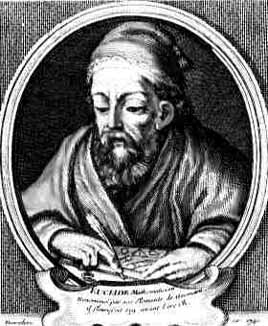
Picture from MacTutor Archives.

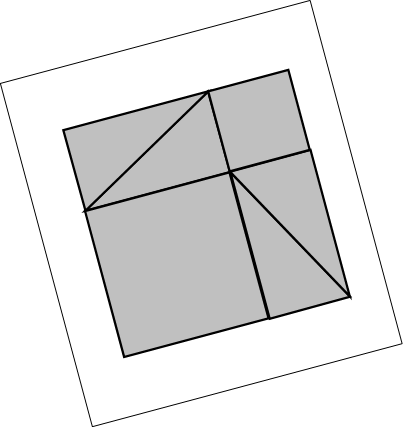
After the Pythagorean crisis with the square root of two, Greek mathematicians tried to avoid working with numbers. Instead, the Greeks used geometry to demonstrate mathematical concepts. A line can be drawn any length, so straight lines became a sort of non-algebraic variable.

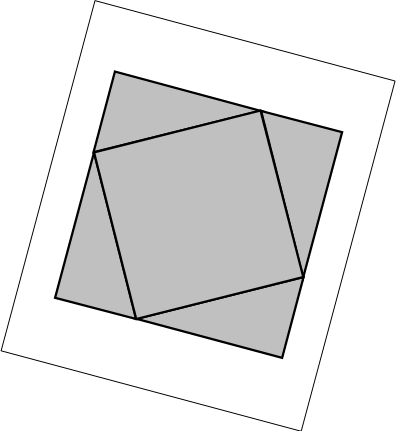
You can see an example of this in The Pythagorean Proof, where Alexandria Jones represented the sides of her triangle by the letters a and b. These sides may be any length. The sizes of the squares will change with the triangle sides, but the relationship a^2 + b^2 = c^2 is always true for every right triangle.
Continue reading Euclid’s Geometric Algebra

The Mosaic Tile Mystery

Dear Alexandria Jones,

We continue to excavate the ancient building complex, which I believe may have been Pythagoras’s school. Yesterday, one of our digging crews uncovered a mosaic tile floor in the courtyard. The pattern of the tiles alternates between two square designs. (See enclosed sketches.)

During your family’s recent visit, you expressed an interest in the mathematical ideas of Pythagoras. Could you or your father offer us any insight into what these tile designs may represent?

I look forward to your response.

Sincerely,
Sofia Theano, Ph.D.
Crotone, Italy

Continue reading The Mosaic Tile Mystery

Answers to Leon’s Figurate Number Puzzles

Remember the Math Adventurer’s Rule: Figure it out for yourself! Whenever I give a problem in an Alexandria Jones story, I will try to post the answer soon afterward. But don’t peek! If I tell you the answer, you miss out on the fun of solving the puzzle. So if you haven’t worked these problems yet, go back to the original post. Figure them out for yourself — and then check the answers just to prove that you got them right.

Continue reading Answers to Leon’s Figurate Number Puzzles

Puzzle: Figuring Out Figurate Numbers


Photo by frumbert.

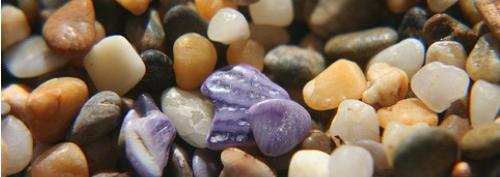
Alexandria Jones‘s parents decided that the family needed to relax after the excitement of tracking Simon Skulk, so they spent the next day at a beach on the Mediterranean coast. Leon collected pebbles and tried to build up figurate numbers — numbers that make a figure, or shape — the way Dr. Theano had shown them.

Continue reading Puzzle: Figuring Out Figurate Numbers