[Photo by theogeo.]
Christmas afternoon is a slow time at our house. How shall we while away the hours until the turkey is done? With math, of course!
Check out this puzzle from Blinkdagger.
[Photo by theogeo.]
Christmas afternoon is a slow time at our house. How shall we while away the hours until the turkey is done? With math, of course!
Check out this puzzle from Blinkdagger.
[Fature photo above by ThunderChild tm.]
The last couple of weeks, in Math Club, we’ve been learning to count. My new set of MathCounts students have never heard of combinatorics, so we started at the very beginning:
- Counting and Probability I by Keone Hon
- Counting and Probability by Jason Batterson
 In the treasure-hunting game of Geocaching (pronounced “geo-cashing”), players use GPS systems to locate boxes hidden at different geographical locations across the country.
Now, the creative people at Mathbits.com have come up with an online treasure-hunting activity for junior high and high school students, called MathCaching. Students solve mathematical problems to find hidden “boxes” on the Internet. Each box reveals clues to the location of the next one.
The MathCaching game covers pre-algebra through trigonometry topics, with calculus levels under development. For more information, visit the MathCaching site, or read the post on my Frugal Homeschooling blog.

I heard of this contest in an e-mail from ClickSchooling:
Kids, share your creative math ideas! Describe how you use math in any activity you love to do — a sport, game, craft, hobby, or anything else.
Send in a description of the activity and how it uses math, as well as any drawing(s) or diagram(s). There are many great prizes to be won. Please ensure you’ve read and understand our contest’s rules and regulations before entering.
Sounds like fun! If you want to enter, act quickly. Entries must be submitted online by July 30th. Visit Crazy4Math.com for more information and to check out the winners from previous years.
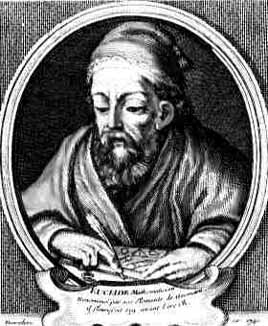
Picture from MacTutor Archives.
After the Pythagorean crisis with the square root of two, Greek mathematicians tried to avoid working with numbers. Instead, the Greeks used geometry to demonstrate mathematical concepts. A line can be drawn any length, so straight lines became a sort of non-algebraic variable.
You can see an example of this in The Pythagorean Proof, where Alexandria Jones represented the sides of her triangle by the letters a and b. These sides may be any length. The sizes of the squares will change with the triangle sides, but the relationship 

[In the last episode, Alexandria Jones received a letter from archaeologist Sofia Theano, asking for help with a Pythagorean puzzle.]
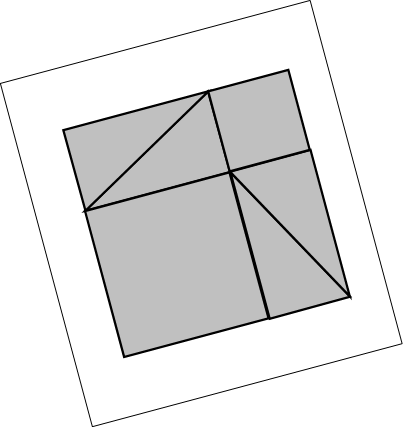
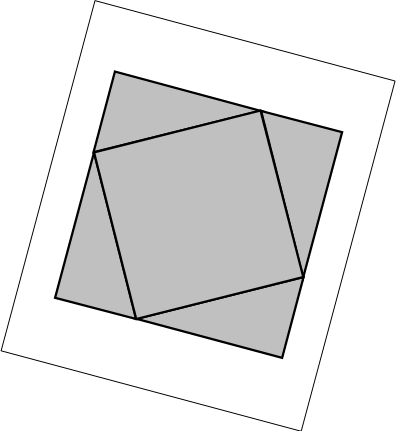
We continue to excavate the ancient building complex, which I believe may have been Pythagoras’s school. Yesterday, one of our digging crews uncovered a mosaic tile floor in the courtyard. The pattern of the tiles alternates between two square designs. (See enclosed sketches.)
During your family’s recent visit, you expressed an interest in the mathematical ideas of Pythagoras. Could you or your father offer us any insight into what these tile designs may represent?
I look forward to your response.
Sincerely,
Sofia Theano, Ph.D.
Crotone, Italy
[When Alexandria Jones and her family visited an excavation in southern Italy, they learned several tidbits about the ancient school of mathematics and philosophy founded by Pythagoras. Here is Alex’s favorite story.]
It hit the Pythagorean Brotherhood like an earthquake, a crisis of faith which shook the foundations of their universe. Some say Pythagoras himself made the dread discovery, others blame Hippasus of Metapontum.
Something certainly did happen with Hippasus. The Brotherhood sent him into exile for insubordination, or for breaking the rule of secrecy — or was it for proving the unthinkable? According to legend, Hippasus drowned at sea, but was it a mere shipwreck or the wrath of the gods? Some say the irate Pythagoreans threw him overboard…
Photo by RBerteig. Take a break from “serious” math and have a little fun today with some classics of recreational mathematics. Do you have a favorite math or logic fallacy? Please share it in the Comments below. Continue reading April Fool’s Day: Fun with Math Fallacies
My pre-algebra class hit the topic of equations just as the NFL season moved into the playoffs. The result was this series of class notes called “The Game of Algebra.”
We used the Singapore Math NEM 1 textbook, which is full of example problems and quality exercises. These notes simply introduce or review the main concepts and vocabulary in a less-textbooky way.
I hope you find them useful.