With the pandemic still raging, most of us will have to adapt our normal holiday traditions to fit the new reality. We may not be able to have a big family gathering (except over Zoom), but we can still enjoy great food.
So for those of you who are planning ahead, here is a mathematician’s menu for next week’s Thanksgiving dinner.
While searching for posts to add to the Playful Math Carnival, I stumbled on a new-to-me math holiday.
Hamilton Day celebrates mathematical discovery — that “Aha!” moment when your eyes are opened and you see something new.
Or something new-to-you. That’s worth celebrating, too.
History of Hamilton Day
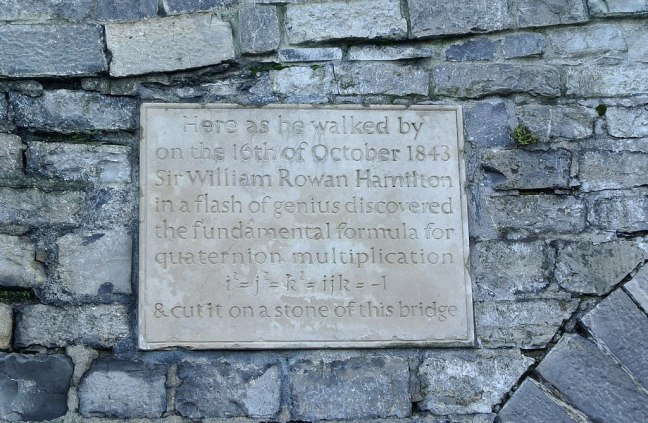
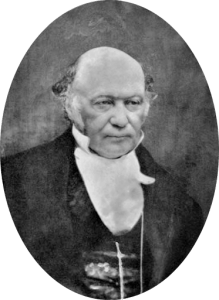
Irish mathematician William R. Hamilton was struggling with a tough math problem in October, 1843. It had him stumped. Then on the 16th, as he walked along Dublin’s Royal Canal with his wife, inspiration struck.
He suddenly realized he could look at the problem from a new direction, and that would make everything fall into place.
“And here there dawned on me the notion that we must admit, in some sense, a fourth dimension of space for the purpose of calculating with triples … An electric circuit seemed to close, and a spark flashed forth.”
—Sir William Rowan Hamilton
In one of the most famous acts of vandalism in math history, Hamilton pulled out a knife and scratched his new equation into the stone of the Broome Bridge: i² = j² = k² = ijk = -1.
Also by Hamilton
“Who would not rather have the fame of Archimedes than that of his conqueror Marcellus?”
—Sir William Rowan Hamilton
quoted in H. Eves, Mathematical Circles Revisited
Why Celebrate Hamilton Day
“So there’s much to celebrate on Hamilton Day. Beyond its utility, we can appreciate mathematics as a human endeavor, with struggles and setbacks and triumphs. We can highlight the opportunity math affords for daring, creativity, and out-of-the-box thinking.
“Hamilton Day could, in other words, pivot away from Pi Day’s gluttony and memorization, neither of which is part of mathematics, toward the intellectual freedom and drama that are.”
Talk about how it feels when you learn something new and it finally makes sense.
I’ve penciled Hamilton Day (October 16) into my calendar for next year.
How about you?
I’d love to hear your ideas for celebrating math! Please share in the comments section below.
* * *
This blog is reader-supported.
If you’d like to help fund the blog on an on-going basis, then please join me on Patreon for mathy inspiration, tips, and an ever-growing archive of printable activities.
If you liked this post, and want to show your one-time appreciation, the place to do that is PayPal: paypal.me/DeniseGaskinsMath. If you go that route, please include your email address in the notes section, so I can say thank you.
Now is the accepted time to make your regular annual good resolutions. Next week you can begin paving hell with them as usual.
Yesterday, everybody smoked his last cigar, took his last drink, and swore his last oath. Today, we are a pious and exemplary community. Thirty days from now, we shall have cast our reformation to the winds and gone to cutting our ancient shortcomings considerably shorter than ever. We shall also reflect pleasantly upon how we did the same old thing last year about this time.
However, go in, community. New Year’s is a harmless annual institution, of no particular use to anybody save as a scapegoat for promiscuous drunks, and friendly calls, and humbug resolutions, and we wish you to enjoy it with a looseness suited to the greatness of the occasion.
If you’d like to enjoy a mathematical New Year’s Resolution, may I recommend Evelyn Lamb’s Math Reading Challenge? I haven’t decided if I’m going to follow along, but it does look like fun.
Meanwhile, I do resolve to challenge myself with more math puzzles this year. Would you like to join me?
Here’s a great way to start: with the 2020 Mathematics Game!
Hapollonian Holiday Greetings from my co-op class kids, and best wishes for a grace-filled holiday season.
Do you know of any great math-related seasonal games, crafts, or activities I missed? Please add them to the comments section below.
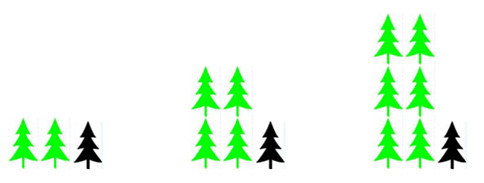
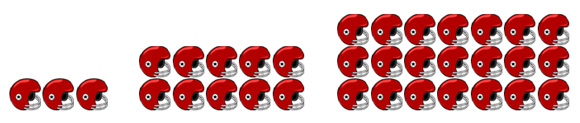
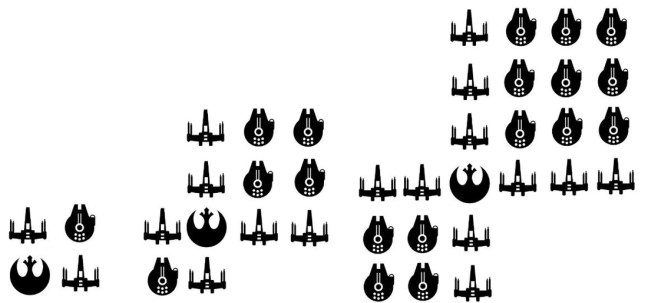
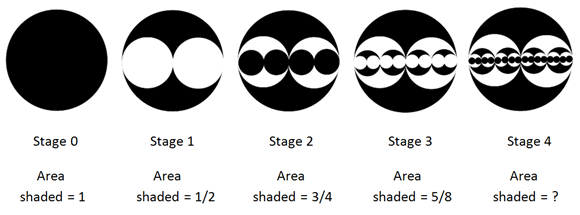
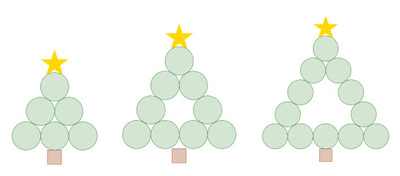
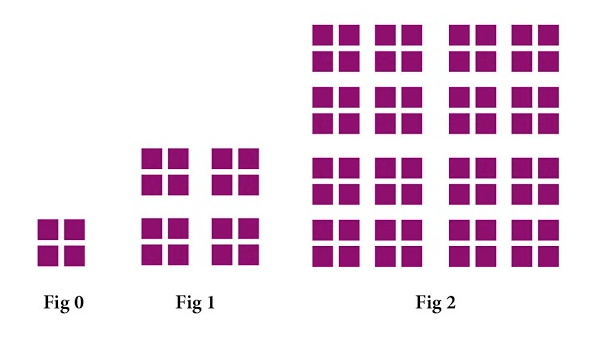
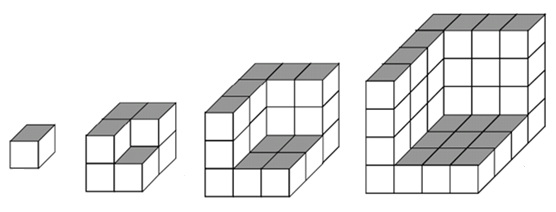
As you scroll through the links below, you find several puzzle graphics from the wonderful Visual Patterns website.
Use them as conversation-starters with your kids: What do you notice? How does each pattern grow?
For older students: Can you write a formula to describe how each pattern? What will it look at stage 43?
Pattern #7, Trees
A Bit of Fun
Setting the mood: Enjoy this bit of seasonal fidgeting from Vi Hart. If you don’t understand some of the references, that’s normal! Pick a phrase, Google it, and enjoy the fun of learning something new.
Every year, some of my favorite websites offer a seasonal selection of activities to encourage your children’s (and your own!) mathematical creativity, one for each day in the run-up to Christmas.
Colleen Young updates the list every year, so check out her pages:
Clarissa (@c0mplexnumber) demonstrates how to make beautiful, challenging origami snowflakes. She recommends beginners try the first few folds — which create a pretty cool design on their own. Let it Snow…
K (@Ms_Kmp) reviews the distributive property with Algebra snowflakes and links to a make-your-own puzzle generator for math review at any level. Or download one of Craig’s (@mrbartonmaths) pre-made Tarsia Jigsaws.
Speaking of Christmas carols, the Christmas Price Index shows the current cost for one set of each of the gifts given in the song “The Twelve Days of Christmas.” I wonder what’s the cumulative cost of all the gifts, when you count each repetition in the song?
Alexandria Jones and her family are fictional characters from my old Mathematical Adventures newsletter. Their stories appear sporadically as I find time to transcribe them from the back-issues. You can find them all on this blog page.
Here are all the Alexandria Jones stories Christmas stories, with activity and craft ideas…
Do you enjoy math? I hope so! If not, the links in this post just may change your mind.
Welcome to the 114th edition of the Math Teachers At Play math education blog carnival — a smorgasbord of articles by bloggers all around the internet who have great ideas for learning, teaching, and playing around with math from preschool to pre-college.
By the way, I found a cool, semi-self-referential trivia tidbit about our carnival number: 27 − 14 = 114. And if you put 114 dots into a 1←7 Exploding Dots machine, you’ll get the code 222. Pretty neat!
As you scroll through the links below, you find several puzzle graphics from the wonderful Visual Patterns website. Use them as conversation-starters with your kids: What do you notice? How does each pattern grow? For older students: Can you write a formula to describe how each pattern? What will it look at stage 43?
Pattern #7, Trees
A BIT OF FUN
Setting the mood: Enjoy this bit of seasonal fidgeting from Vi Hart (@vihartvihart).
If you don’t understand some of the references, that’s normal! Pick a phrase, Google it, and enjoy the fun of learning something new.
TABLE OF CONTENTS
And now, on to the main attraction: the blog posts. Some articles were submitted by their authors; others were drawn from the immense backlog in my rss reader. If you’d like to skip directly to your area of interest, click one of these links.
Two of the most popular New Year’s Resolutions are to spend more time with family and friends, and to get more exercise. The 2017 Mathematics Game is a prime opportunity to do both at once.
So grab a partner, slip into your workout clothes, and pump up those mental muscles!
For many years mathematicians, scientists, engineers and others interested in mathematics have played “year games” via e-mail and in newsgroups. We don’t always know whether it is possible to write expressions for all the numbers from 1 to 100 using only the digits in the current year, but it is fun to try to see how many you can find. This year may prove to be a challenge.
Use the digits in the year 2017 to write mathematical expressions for the counting numbers 1 through 100. The goal is adjustable: Young children can start with looking for 1-10, middle grades with 1-25.
You must use all four digits. You may not use any other numbers.
Solutions that keep the year digits in 2-0-1-7 order are preferred, but not required.
You may use a decimal point to create numbers such as .2, .02, etc., but you cannot write 0.02 because we only have one zero in this year’s number.
You may create multi-digit numbers such as 10 or 201 or .01, but we prefer solutions that avoid them.
My Special Variations on the Rules
You MAY use the overhead-bar (vinculum), dots, or brackets to mark a repeating decimal. But students and teachers beware: you can’t submit answers with repeating decimals to Math Forum.
You MAY use a double factorial, n!! = the product of all integers from 1 to n that have the same parity (odd or even) as n. I’m including these because Math Forum allows them, but I personally try to avoid the beasts. I feel much more creative when I can wrangle a solution without invoking them.
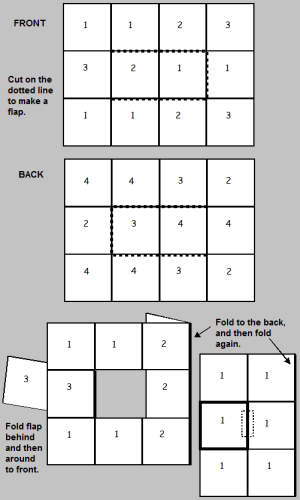
Here’s how Alex created tetra-tetraflexagon Christmas cards to send to her friends:
1. Buy a pack of heavy paper at the office supply store. Regular construction paper tears too easily.
2. Measure and divide the paper into fourths one direction and thirds the other way. Fold each line backward and forward a few times.
3. Number the front and back of the paper in pencil, lightly, as shown. Then carefully cut a center flap along the dotted lines.
4. Fold the paper along the dark lines as shown, so the center flap sticks out from underneath and the right-hand column shows all 2’s.
5. Fold the flap the rest of the way around to the front and fold the right-hand column under again. (Shown as dark lines on the diagram.) This makes the front of the flexagon show 1’s in every square.
6. Carefully, tape the flap to its neighbor on the folded column. Don’t let the tape stick to any but these two squares.
7. Gently erase your pencil marks.
Find All the Faces
A tetra-tetraflexagon has four faces: front, back, and two hidden. It is shaped like a tetragon — better known as a rectangle.
Here’s how to flex your tetra-tetraflexagon card:
Face 1 is easy to find. It’s on top when you make the card.
Turn the card over to find Face 2.
Face 3 is hidden behind Face 2. Fold your flexagon card in half (vertically) so that Face 1 disappears. Unfold Face 2 at the middle, like opening a book. Face 3 should appear like magic.
Face 4 is hidden behind Face 3. Fold the card (vertically) to hide Face 2, then open the middle of Face 3. Face 2 vanishes, and Face 4 is finally revealed.
When Faces 2 and 3 are folded to the back, you will notice that any pictures you drew on them will look scrambled. What happened?
Add Your Designs
Alex wrote a holiday greeting on Face 1. Then she drew Christmas pictures on the other three faces of her card.
The Jones family sat around the dining table performing a traditional holiday ritual: the Christmas card assembly line.
First, Dr. Fibonacci Jones (the world-famous mathematical archaeologist) signed for himself and his wife. He handed the card to Alex, who signed for herself and baby Renée. Then Alex’s younger brother Leon added his own flourish. Finally, Mrs. Jones wrote a personal note on the cards going to immediate family and close friends.
One-year-old Renée sat in her high chair, chewing the corners of an extra card.
Alex Poses a Problem
Alex dropped her pen and shook out her tired fingers.
“I’m stumped,” she said. “I’d like to send a special Christmas card to some of my friends from camp last summer. But I can’t think of anything that seems good enough.”
Leon leaned his chair back in thought.
Then he snapped his fingers. “I’ve got it! We’ll throw a handful of sand in each of their envelopes. You know, to make them remember all the fun you guys had digging up old stuff.”
Alex humphed. “How would you like to get sand in your Christmas present?” she asked. “Besides, it wasn’t stuff. It was artifacts.”
“You should not make such a display of your ignorance, young man,” Dr. Jones said. “Stuff, indeed!”
Mrs. Jones put her hand to her forehead and sighed dramatically. Then she turned to Alex. “Have you considered doing a jigsaw puzzle card? They sell them at the hobby store.”
“I’ve tried those before,” Alex said, “but the ones I had always warped. The puzzles didn’t go back together very well.”
Dad Gets an Idea
Dr. Jones got an out-of-focus, “I’m thinking” look in his eyes. He stood up, tapped his chin with his pen, and walked away. He almost ran into the wall, but he caught himself. Shaking his head, he disappeared into his study.
Mrs. Jones put down her pen and picked up Renée.
“Why don’t you two address those envelopes while we wait for your dad’s inspiration to reveal itself? I need to put a little one down to S-L-E-E-P.”
Alex laughed. “If you keep that up, Renée will learn to spell before she’s out of diapers!”
Leon thumbed the stack of envelopes and groaned. “C’mon, sis. Back to work!”
Before long, Mrs. Jones came back and chased the kids away from the table. “I’ll finish this,” she said.
Unfolding the Magic
Alex and Leon ran to the study. They found Dr. Jones at his desk, playing with a piece of paper.
“Ah, there you are,” he said. “Here, Alex. What do you think?”
“Well,” she said, “it looks like a regular piece of paper that’s been folded over on itself.”
Dr. Jones nodded. “Now you know a sheet of paper has two faces—that is, it has a front and a back.”
Leon reached for the paper and flipped it over. “Is that why you put red stripes on one side and blue stripes on the other?”
“Observe,” Dr. Jones said.
He took the piece of paper and folded it in half. Then he unfolded it and handed it to Alex.
“Hey, how’d you do that?” she asked. “Now there are blue polka-dots on this side.”
“Cool! It’s magic,” Leon said.
“It is called a tetra-tetraflexagon,” Dr. Jones said, “and it has one more hidden face. Can you find it?”
Alex folded the paper this way and that. Then she held it up in triumph.
“Look, red dots—I did it!”
She gave her dad a tremendous hug. “Thanks, Dad! I’ll make magic flexagons. They’ll be the best Christmas cards ever!”

 Irish mathematician William R. Hamilton was struggling with a tough math problem in October, 1843. It had him stumped. Then on the 16th, as he walked along Dublin’s Royal Canal with his wife, inspiration struck.










 Here’s how Alex created tetra-tetraflexagon Christmas cards to send to her friends:
 Denise Gaskins' Let's Play Math
_regarding_the_discovery_of_Quaternions_multiplication_by_Sir_William_Rowan_Hamilton.jpg)

