Alexandria Jones and her family are fictional characters from my old Mathematical Adventures newsletter. Their stories appear sporadically as I find time to transcribe them from the back-issues. You can find them all on this blog page.
Here are all the Alexandria Jones stories Christmas stories, with activity and craft ideas…
Alexandria Jones and the Christmas Present Quandary
Alex designs tessellation wrapping paper, hunts for the perfect Christmas tree, and comes up with a lively present for her brother. We meet the rest of Alex’s family — her father was introduced in an earlier issue — along with historical figures Maria Agnesi and Leonhard Euler, and we take a brief glance at mathematics from China.
And New This Year: Alexandria Jones and the Magic Christmas Cards
Dr. Jones suggests a way to make the “best Christmas cards ever” (according to Alex), and the Jones children create geometric gifts to celebrate the holiday.
Back when we were still homeschooling, I always dropped the “regularly scheduled program” in December. School plus holiday prep added up to one stressed-out mom.
Instead, we read plenty of library books. And we played around with informal activities like the NrichMaths Advent Calendars:
For older students and adults, the online Plus Magazine offers a calendar of daily tidbits from their “Maths in a minute” series, explaining important mathematical concepts in just a few words”
How do you handle schoolwork during this busy season? I’m collecting new links for an updated Holiday Math post next month. I’d love to hear your ideas!
June 17 marks World Tessellation Day, a holiday I created to bring awareness to the fun of finding and making tessellations.
Will you celebrate with us?
Here are 10 great ways to play with tessellations, learn about them, and introduce your children to a math concept that opens a variety of creative learning opportunities.
1) Learn about tessellations with your kids.
A tessellation is a tiled mosaic pattern of the same shape laid out over and over again, repeating into infinity. Tessellations can be found in nature, or they can be created by people. Learn more at these websites:
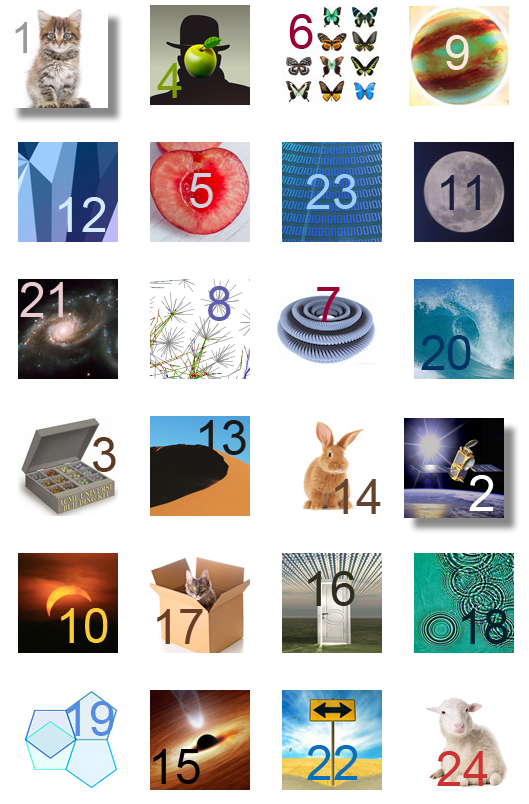
Once again, Nrich.Maths.org and Plus.Maths.org are offering a selection of activities to encourage your students’ mathematical creativity, one for each day in the run-up to Christmas. Click one of the images below to visit the appropriate Advent Math Calendar page.
“Wild Maths” puzzles and articles for teens and up. When you get to the +Plus Magazine website, you can tell which links are live by the drop shadow under the picture. One link becomes live each day — so come back tomorrow and discover something new!
You know you’re a math teacher when you see a penny in the parking lot, and your first thought is, “Cool! A free math manipulative.”
My homeschool co-op math students love doing math with pennies. They’re rather heavy to carry to class, but worth it for the student buy-in.
This month, I’m finishing up the nearly 150 new illustrations for the upcoming paperback edition of my Let’s Play Math book. I’m no artist, and it’s been a long slog. But a couple of the graphics involved pennies—so when I saw that penny on the ground, it made me think of my book.
And thinking of my book made me think it would be fun to share a sneak peek at coming attractions…
The Penny Square: An Example of Real Mathematics
Real mathematics is intriguing and full of wonder, an exploration of patterns and mysterious connections. It rewards us with the joy of the “Aha!” feeling. Workbook math, on the other hand, is several pages of long division by hand followed by a rousing chorus of the fraction song: “Ours is not to reason why, just invert and multiply.”
Real math is the surprising fact that the odd numbers add up to perfect squares (1, 1 + 3, 1 + 3 + 5, etc.) and the satisfaction of seeing why it must be so.
Did your algebra teacher ever explain to you that a square number is literally a number that can be arranged to make a square? Try it for yourself:
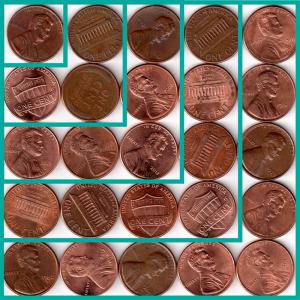
Gather a bunch of pennies—or any small items that will not roll away when you set them out in rows—and place one of them in front of you on the table. Imagine drawing a frame around it: one penny makes a (very small) square. One row, with one item in each row.
Now, put out three more pennies. How will you add them to the first one in order to form a new, bigger square? Arrange them in a small L-shape around the original penny to make two rows with two pennies in each row.
Set out five additional pennies. Without moving the current four pennies, how can you place these five to form the next square? Three rows of three.
Then how many will you have to add to make four rows of four?
Twenty-five is a square number, because we can arrange twenty-five items to make a square: five rows with five items in each row.
Each new set of pennies must add an extra row and column to the current square, plus a corner penny where the new row and column meet. The row and column match exactly, making an even number, and then the extra penny at the corner makes it odd.
Can you see that the “next odd number” pattern will continue as long as there are pennies to add, and that it could keep going forever in your imagination?
The point of the penny square is not to memorize the square numbers or to get any particular “right answer,” but to see numbers in a new way—to understand that numbers are related to each other and that we can show such relationships with diagrams or physical models. The more relationships like this our children explore, the more they see numbers as familiar friends.
The Penny Birthday Challenge: Exponential Growth
A large jar of assorted coins makes a wonderful math toy. Children love to play with, count, and sort coins.
Add a dollar bill to the jar, so you can play the Dollar Game: Take turns throwing a pair of dice, gathering that many pennies and trading up to bigger coins. Five pennies trade for a nickel, two nickels for a dime, etc. Whoever is the first to claim the dollar wins the game.
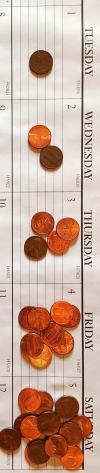
Or take the Penny Birthday Challenge to learn about exponential growth: Print out a calendar for your child’s birthday month. Put one penny on the first day of the month, two pennies on the second day, four pennies on the third day, etc. If you continued doubling the pennies each day until you reach your child’s birthday, how much money would you need?
Warning: Beware the Penny Birthday Challenge! Those pennies will add up to dollars much faster than most people expect. Do not promise to give the money to your child unless the birthday comes near the beginning of the month.
A Penny Holiday Challenge
The first time I did pennies on a calendar with my homeschool co-op class was during December, so we called it the Penny Christmas Challenge:
How many pennies would you need to cover all the days up to the 25th?
I told the kids that if their grandparents asked what gift they wanted for Christmas, they could say, “Not much. Just a few pennies…”
The Penny Square, Dollar Game, and Penny Birthday Challenge are just three of the myriad math tips and activity ideas in the paperback edition of Let’s Play Math: How Families Can Learn Math Together and Enjoy It. Coming in early 2016 to your favorite online bookstore…
Did you know that playing games is one of the Top 10 Ways To Improve Your Brain Fitness? So slip into your workout clothes and pump up those mental muscles with the Annual Mathematics Year Game Extravaganza!
For many years mathematicians, scientists, engineers and others interested in math have played “year games” via e-mail. We don’t always know whether it’s possible to write all the numbers from 1 to 100 using only the digits in the current year, but it’s fun to see how many you can find.
Use the digits in the year 2015 to write mathematical expressions for the counting numbers 1 through 100. The goal is adjustable: Young children can start with looking for 1-10, middle grades with 1-25.
You must use all four digits. You may not use any other numbers.
Solutions that keep the year digits in 2-0-1-5 order are preferred, but not required.
You may use a decimal point to create numbers such as .2, .02, etc., but you cannot write 0.02 because we only have one zero in this year’s number.
You may create multi-digit numbers such as 10 or 201 or .01, but we prefer solutions that avoid them.
My Special Variations on the Rules
You MAY use the overhead-bar (vinculum), dots, or brackets to mark a repeating decimal. But students and teachers beware: you can’t submit answers with repeating decimals to Math Forum.
You MAY NOT use a double factorial, n!! = the product of all integers from 1 to n that have the same parity (odd or even) as n. Math Forum allows these, but I’ve decided I prefer my arithmetic straight.
 Back when we were still homeschooling, I always dropped the “regularly scheduled program” in December. School plus holiday prep added up to one stressed-out mom.


 Denise Gaskins' Let's Play Math