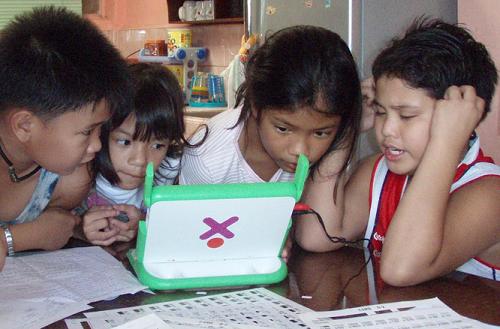
[Photo by One Laptop Per Child.]
Once again, I am adding to my Free (Mostly) Math Resources page. Here are a handful of helpful websites for teaching math…
[Photo by One Laptop Per Child.]
Once again, I am adding to my Free (Mostly) Math Resources page. Here are a handful of helpful websites for teaching math…
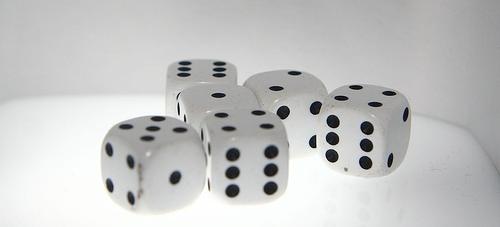
[Fature photo above by ThunderChild tm.]
The last couple of weeks, in Math Club, we’ve been learning to count. My new set of MathCounts students have never heard of combinatorics, so we started at the very beginning:
- Counting and Probability I by Keone Hon
- Counting and Probability by Jason Batterson

[Photo by geishaboy500 via Flickr (CC BY 2.0).]
Are you looking for creative ways to help your children study math? Even without a workbook or teacher’s manual, your kids can learn a lot about numbers. Just spend an afternoon playing around with a hundred chart (also called a hundred board or hundred grid).
 My free 50-page PDF Hundred Charts Galore! printables file features 1–100 charts, 0–99 charts, bottom’s-up versions, multiple-chart pages, blank charts, game boards, and more. Everything you need to play the activities below and those in my new 70+ Things to Do with a Hundred Chart book.
Download Free “Hundred Charts Galore!” Printables
Shop for “70+ Things To Do with a Hundred Chart” Book
And now, let’s play…
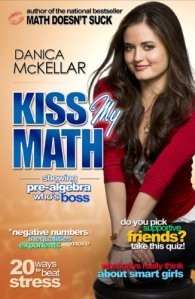
Pre-algebra students stand at the threshold of adventure. Behind them lie the rocky plains of school arithmetic. Ahead, the trail winds into a murky, tangled woods and disappears in the shadows. Who knows what monsters might live in a place like that?
Actress and math maven Danica McKellar has traveled through the pre-algebra jungle and beyond, up the slopes to higher math. She survived the journey, and now, on the heels of her bestselling book for math-phobic middle schoolers, she has written Kiss My Math to guide uncertain students along their way.
Unlike the case with most Hollywood movies, this sequel is an improvement.
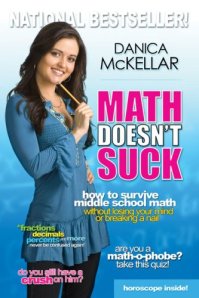
We’ve all heard the saying, Don’t judge a book by its cover, but I did it anyway. Well, not by the cover, exactly — I also flipped through the table of contents and read the short introduction. And I said to myself, “I don’t talk like this. I don’t let my kids talk like this. Why should I want to read a book that talks like this? I’ll leave it to the public school kids, who are surely used to worse.”
Okay, I admit it: I’m a bit of a prude. And it caused me to miss out on a good book. But now Danica McKellar‘s second book is out, and the first one has been released in paperback. A friendly PR lady emailed to offer me a couple of review copies, so I gave Math Doesn’t Suck a second chance.
I’m so glad I did.
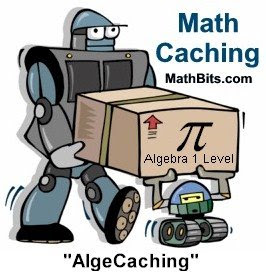 In the treasure-hunting game of Geocaching (pronounced “geo-cashing”), players use GPS systems to locate boxes hidden at different geographical locations across the country.
Now, the creative people at Mathbits.com have come up with an online treasure-hunting activity for junior high and high school students, called MathCaching. Students solve mathematical problems to find hidden “boxes” on the Internet. Each box reveals clues to the location of the next one.
The MathCaching game covers pre-algebra through trigonometry topics, with calculus levels under development. For more information, visit the MathCaching site, or read the post on my Frugal Homeschooling blog.

I heard of this contest in an e-mail from ClickSchooling:
Kids, share your creative math ideas! Describe how you use math in any activity you love to do — a sport, game, craft, hobby, or anything else.
Send in a description of the activity and how it uses math, as well as any drawing(s) or diagram(s). There are many great prizes to be won. Please ensure you’ve read and understand our contest’s rules and regulations before entering.
Sounds like fun! If you want to enter, act quickly. Entries must be submitted online by July 30th. Visit Crazy4Math.com for more information and to check out the winners from previous years.
 [Photo by Vox Efx.]
School’s out — and what could be more fun in the lazy, hazy days of summer than to study math? Check out these articles from Maria Miller of Homeschool Math Blog:
Photo by jaycoxfilm.
Math concepts: mental calculations, math vocabulary, and anything else you want to include
Number of players: any number, but I think it works best with two players who alternate asking questions
Equipment: imagination and, if necessary, scratch paper
Many years ago, I read a magazine article by mathematical music critic Edward Rothstein, wherein he described a game he invented for his daughter:
Rather than explaining the rules of the game, let me tell you a story…
Photo by Mike Licht, NotionsCapital.com.
The cold came back and knocked me flat, but there are compensations. The downtime gave me a chance to browse my overflowing bookmarks folder, and I found something to add to my resource page. Princess Kitten and I enjoyed exploring these games and quizzes from Ambleweb.
 Denise Gaskins' Let's Play Math