Magic Square Puzzles

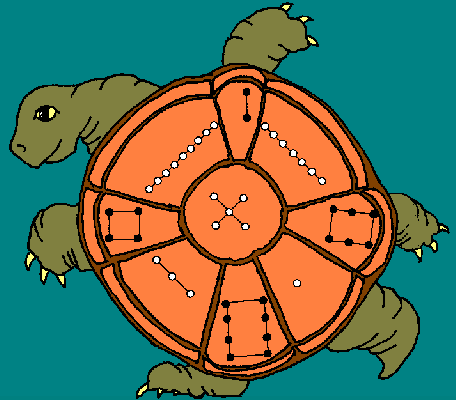
Lo-shu turtle

Alex handed her brother Leonhard a box wrapped in the rocket tessellation paper, with air holes carefully punched in two sides.

“Merry Christmas, Leon!” she said.

He ripped open the gift. Alex winced. Boys have no artistic appreciation, she thought.

“Oh, cool! Thanks,” Leon said.

“His name is Lo-shu,” said Alex. “But be careful. I used non-toxic tempera paint. The design will was off.”

Leon turned the turtle and studied the back of its shell. “Oh, that’s just like in the legend! I’ll copy it down before I let him near any water.”

  • What do the shapes on Lo-shu’s back mean?
  • Why are some dots white and some black?

Continue reading Magic Square Puzzles

Leon’s Christmas Gift

Lo-shu turtle

Here is the simplest puzzle from the November/December 1998 issue of Alexandria Jones stories. The answer (and more puzzles) will follow.

Christmas gift for Leon (pdf, 68KB)

Edited to Add

More puzzles are now here:

Magic square puzzles

Answers are also posted:

Christmas puzzle answers

To Be Continued…

Read all the posts from the November/December 1998 issue of my Mathematical Adventures of Alexandria Jones newsletter.

Solving Complex Story Problems II

[Oops! I found one more post from my old blog. It apparently slipped off the back of my metaphorical desk and has been sitting with the dust bunnies.]

Here is a math problem in honor of one of our family’s favorite movies

Han Solo was doing some needed maintenance on the Millennium Falcon. He spent 3/5 of his money upgrading the hyperspace motivator. He spent 3/4 of the remainder to install a new blaster cannon. If he spent 450 credits altogether, how much money did he have left?

[Modified from a word problem in Singapore Primary Math 5B. Stop and think about how you would solve it before reading further.]

Continue reading Solving Complex Story Problems II

How Shall We Teach Fractions?

How did you fare on the Frustrating Fractions Quiz? With so many apparent inconsistencies, we can all see why children (and their teachers) get confused. And yet, fractions are vital to our children’s test scores — and scores are important to college admissions officers. What is a teacher to do? Must we tell our children, “Do it this way, and don’t ask questions”?

Parents and teachers are tempted to wonder if the struggle is worth it. After all, how often do you divide by a fraction in your adult life? If only we could skip the hard stuff…

Continue reading How Shall We Teach Fractions?

Quiz: Those Frustrating Fractions

[Photo by jimmiehomeschoolmom.]

Fractions confuse almost everybody. In fact, fractions probably cause more math phobia among children (and their parents) than any other topic before algebra. Middle school textbooks devote a tremendous number of pages to teaching fractions, and still many students find fractions impossible to understand. Standardized tests are stacked with fraction questions.

Fractions are a filter, separating the math haves from the luckless have nots. One major source of difficulty with fractions is that the rules do not seem to make sense. Can you explain these to your children?

Start with an easy one…

Question #1

If you need a common denominator to add or subtract fractions…

  • Why don’t you need a common denominator when you multiply?

Continue reading Quiz: Those Frustrating Fractions

Elementary Problem Solving: The Tools

[This article begins a series rescued from my old blog. Moving has been a long process, but I’m finally unpacking the last cardboard box! To read the entire series, click here: elementary problem solving series.]

Most young students solve story problems by the flash of insight method: When they read the problem, they know almost instinctively how to solve it. This is fine for problems like:

There are 7 children. 2 of them are girls. How many boys are there?

As problems get more difficult, however, that flash of insight becomes less reliable, so we find our students staring blankly at their paper or out the window. They complain, “I don’t know what to do. It’s too hard!”

We need to give our students a tool that will help them when insight fails.

Continue reading Elementary Problem Solving: The Tools

Are You Smarter than a 3rd-6th Grader?

Here are a few challenging word problems from Singapore:

I did fine on the 3rd-grade problems, but I stumbled a bit on the 4/5th-grade “How much sugar…” problem. The toy cars were tricky, but manageable. I misread the problem with the chocolate and sweets at first — I think of chocolates as a sub-category of sweets, but in this problem they are totally different. (Perhaps “sweets” are what I would call “hard candy”?) Finally, I had to resort to algebra for the last two Grade 6 questions.

How many can you solve?

Trouble with Percents

Can your students solve this problem?

There are 20% more girls than boys in the senior class.
What percent of the seniors are girls?

This is from a discussion of the semantics of percent problems and why students have trouble with them, going on over at MathNotations. (Follow-up post here.)

Our pre-algebra class just finished a chapter on percents, so I thought Chickenfoot might have a chance at this one. Nope! He leapt without thought to the conclusion that 60% of the class must be girls.

After I explained the significance of the word “than”, he solved the follow-up problem just fine.