Podcast: Math as a Nature Walk

Pam Barnhill interviewed me for the Your Morning Basket podcast. We had a great talk. I think you’ll enjoy it:

YMB #94 Math in Morning Time: A Conversation with Denise Gaskins

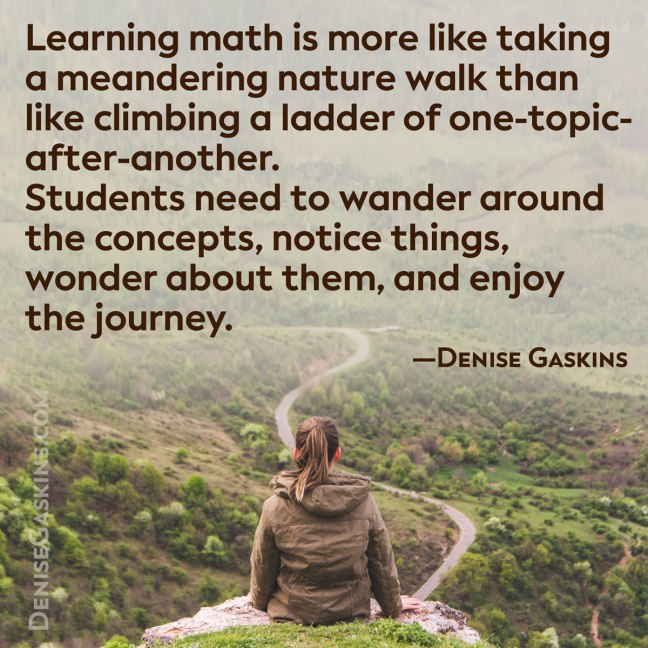
“Let me give you this new vision. I want you to think of math as a nature walk.

    “There’s this whole world of interesting things. More things, more concepts, more ideas than you and your children would ever have time to explore. And everywhere you look, there’s something cool to discover.

      “If you explore this world with your children, you’re not behind. Wherever you are, you’re not behind because there is no behind. There’s only, “We’re going this direction.” Or, “Let’s move that way.” Or, “Hey, look what I found over here!”

        “And as long as your children are thinking and wondering, and making sense of the math they find, they’re going to learn. They’re going to grow.

          “So what you want to do is, you want to embrace this adventure of loving God with all your mind and approach math with an attitude of playful exploration.

            “And you know, you’ll be surprised how much fun thinking hard can be.”

            —Denise Gaskins, Math in Morning Time

            Go Listen to the Interview

             
            * * *

            I thoroughly enjoyed my conversation with Pam. If you run a math, education, or homeschooling podcast, and you’d like to have me on sometime, I’d love to hear from you!

            Are you looking for more creative ways to play math with your kids? Check out all my books, printable activities, and cool mathy merch at Denise Gaskins’ Playful Math Store. Or join my email newsletter.

            This blog is reader-supported. If you’d like to help fund the blog on an on-going basis, then please join me on Patreon for mathy inspiration, tips, and an ever-growing archive of printable activities.

            “Podcast: Math as a Nature Walk” copyright © 2021 by Denise Gaskins. Image at the top of the post copyright © Jessica Rockowitz via Unsplash.com.
            What Is Multiplication, Anyway?

            At some point during the process of teaching multiplication to our children, we really need to come to terms with this question:

            What IS multiplication?

            Did your device hide the video? Find it on YouTube here.

            “What’s my answer? It’s not one that society’s going to like. Because society expects — demands, even — that mathematics be concrete, real-world, absolute, having definitive answers.

              I can’t give a definitive answer.

                Multiplication manifests itself in different ways. So maybe the word ‘is’ there is just too absolute. And it’s actually at odds with what mathematicians do.

                  Mathematicians do attend to real-world, practical scenarios — by stepping away from them, looking at a bigger picture.”

                  —James Tanton, What is Multiplication?

                  For Further Study

                  You may also enjoy these posts from my blog archive:

                  Memorizing the Times Table: A Life Skills Approach

                  Continuing on my theme of times table facts, here’s the inimitable James Tanton:

                  Did your device hide the video? Find it on YouTube here.

                  “If our task is to memorize this table, please make it about mathematics — about thinking your way through a challenge, and what can I do to make my life easier.”

                  —James Tanton, Making Memorising Multiplication Facts (if one really must) a meaningful Life Skill Lesson

                  For Further Study

                  You may also enjoy my blog post series about working through the times tables, paying attention to mathematical relationships (and a bit of prealgebra) along the way.

                  Times Tables Series

                  Click the button to see the whole series. Scroll down to the first post to go through it in order.

                  The Principality of Mathematics

                  quotation from Charlotte Mason: The principality of mathematics is a mountainous land, but the air is very fine and health-giving

                  Here’s the full quote:

                  “The Principality of Mathematics is a mountainous land, but the air is very fine and health-giving, though some people find it too rare for their breathing. People who seek their work or play in this principality find themselves braced by effort and satisfied with truth.”

                  — Charlotte Mason, Ourselves

                  Charlotte Mason and Math

                  Math was not one of Charlotte Mason’s primary interests. She didn’t think or write as deeply about it as she did other subjects.

                  She even wrote, “It is unnecessary to exhibit mathematical work done in the P.U.S. as it is on the same lines and reaches the same standard as in other schools.”

                  This leaves us modern parents and teachers having to read our own interpretations into her words. It should be no surprise when we come to different conclusions. Someday, perhaps, I’ll publish my own vision for a Charlotte Mason approach to homeschooling math.

                  In the meantime, the following articles describe a method that allows even the youngest children to explore the Principality of Mathematics:

                  In the years since writing those posts, Sonya and Lacy combined all their ideas into an easy-to-implement program that I think Mason herself would have enjoyed. Here’s my review:

                  CREDITS: Quote background photo (top) by Kalen Emsley via Unsplash.com.

                  Not Attained by Chance

                  I’ve been collecting quotes about life and learning. They make great discussion-starters or essay/journaling prompts.

                  This is one of my favorites.

                  “Learning is not attained by chance, it must be sought for with ardor and attended to with diligence.”

                  —Abigail Adams

                  [Aw, face it. They’re all my favorites. That’s why I collect them!]

                  If you like quotes, too, you might enjoy browsing my collection:

                  Math & Education Quotations

                  Math as a Verb

                  Here’s the full quote:

                  I like to play games. Almost any type of game.

                  I also like to play math.

                  If you’ve known enough mathematicians, you may have noticed that this isn’t unusual. I’m not sure if a love of games and puzzles among mathematicians exceeds a love of music among mathematicians, but both are strong and intersect.

                  Math in play is also a way of teaching mathematics. I think that as a metaphor, it best describes how I want to teach math.

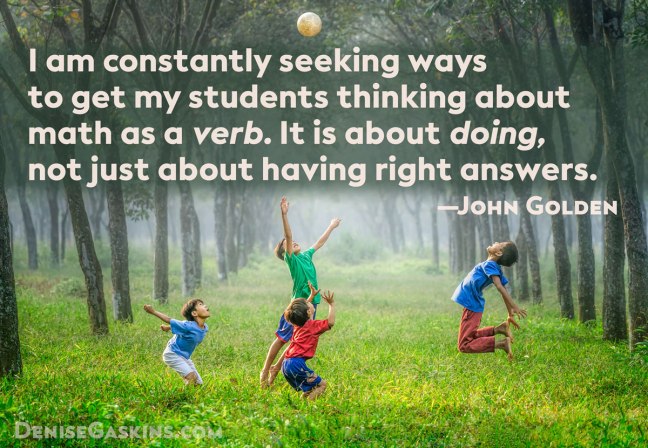
                  I am constantly seeking ways to get my students thinking about math as a verb. It is about doing, not just about having right answers or the end product.

                  Games help set the culture I want to develop: Teaching students that multiple approaches and strategies are valued; trying is safe; and conversations about why, how, and discovery are the goals.

                  —John Golden
                  Yes, Playing Around

                  CREDITS: “Football outside Jakarta” photo by Robert Collins on Unsplash.

                  FAQ: Playful Math for Older Students

                  My students are so busy that time-consuming math projects are a luxury. How is it possible for older kids to play with mathematics?

                  Too often, the modern American school math curriculum is a relentless treadmill driving students toward calculus. (Does this happen in other countries, too?)

                  But that’s definitely not the only way to learn. For most students, it’s not the best way, either.

                  Here are a few ideas to get your older children playing with math…

                  Continue reading FAQ: Playful Math for Older Students

                  The Value of Puzzles

                  I love puzzles. Don’t you?

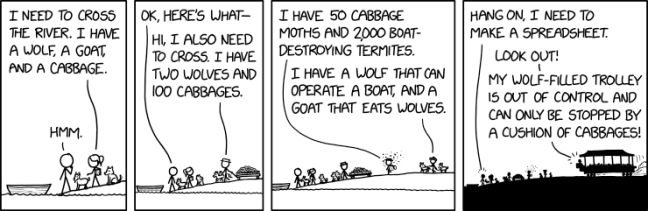
                  Here are several examples of river-crossing puzzles you and your kids can try. They date back at least to the time of Alcuin, the famous scholar from the court of Charlemagne.

                  I wish someone would write a whole math curriculum devoted entirely to puzzles.

                  W.W. Sawyer on the Value of Puzzles

                  Master teacher W.W. Sawyer didn’t write a curriculum, but he often used puzzles in the classroom.

                  “It is quite possible to use simultaneous equations as an introduction to algebra. Within a single lesson, pupils who previously did not know what x meant can come not merely to see what simultaneous equtions are, but to have some competence in solving them.

                  “No rules need to be learnt; the work proceeds on a basis of common sense.

                  “The problems the pupils solve in such a first lesson will not be of any practical value. They will be in the nature of puzzles.

                  “Fortunately, nature has so arranged things that until the age of twelve years or so, children are more interested in puzzles than in realistic problems.”

                  —W. W. Sawyer, Vision in Elementary Mathematics

                  Then he gives this example:

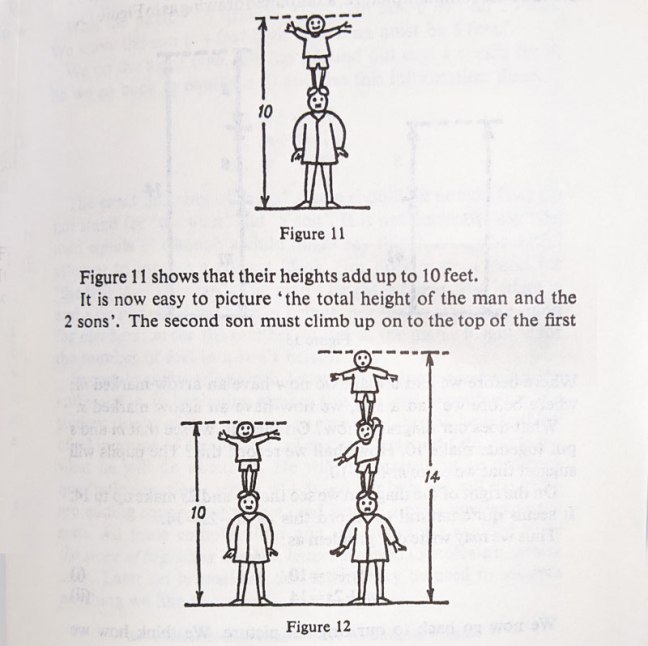
                  “A man has two sons. The sons are twins; they are the same height. If we add the man’s height to the height of one son, we get 10 feet. The total height of the man and the two sons is 14 feet. What are the heights of the man and his sons?”

                  Try This at Home

                  Not only can children solve puzzles like this, but even better — they can make up story puzzles of their own. You could spend a whole week or more making up silly height puzzles for each other to solve. By the time you were done, your kids would have a great introduction to algebra!

                  Maybe I never grew up. Because I still prefer puzzles over “real world” math problems.

                  What are your favorite kinds of puzzles? Please share in the comments section.

                  CREDITS: “Boat puzzles” comic from xkcd.com.
                  [THE FINE PRINT: I am an Amazon affiliate. If you follow the book link and buy something, I’ll earn a small commission (at no cost to you). But this book is a well-known classic, so you should be able to order it through your local library.]

                  More Dover Samples

                  “Without mathematics you can’t do anything! Everything around you is mathematics. Everything around you is numbers.”

                  —Anna Claybourne, I Can Be a Math Magician


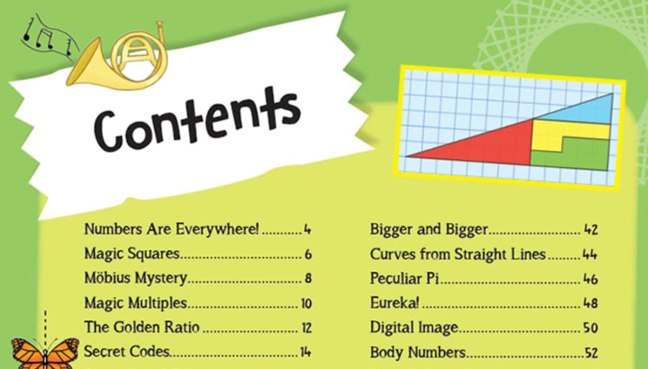
                  Dover Publications sent out a new email today with fun coloring and craft samples. And several puzzles from I Can Be a Math Magician: Fun STEM Activities for Kids by Anna Claybourne.

                  Enjoy!

                  If you’d like to receive future Dover Sampler emails, you can sign up here.

                  THE FINE PRINT: I am an Amazon affiliate. If you follow the book link above and buy something, I’ll earn a small commission (at no cost to you).

                  W.W. Sawyer’s Rules of Mathematics

                  “In the beginnings of arithmetic and algebra, the main purpose is not to get the pupil making calculations. The main purpose is to get him into the habit of thinking, and to show him that he can think the problems out for himself.

                  “Pupils ask ‘Am I allowed to do this?’ as if we were playing a game with certain rules.

                  “A pupil is allowed to write anything that is true, and not allowed to write anything untrue!

                  “These are the only rules of mathematics.”

                  —W. W. Sawyer, Vision in Elementary Mathematics

                  [THE FINE PRINT: I am an Amazon affiliate. If you follow the link and buy something, I’ll earn a small commission (at no cost to you). But this book is a well-known classic, so you should be able to order it through your local library.]

                  Inspired by Sawyer’s Two Rules

                  I love this quote so much, I turned it into a printable math activity guide. I hope it helps inspire your students to deeper mathematical thinking.

                  Here’s the product description…

                  Join the Math Rebellion: Creative Problem-Solving Tips for Adventurous Students

                  Take your stand against boring, routine homework.

                  Fight for truth, justice, and the unexpected answer.

                  Join the Math Rebellion will show you how to turn any math worksheet into a celebration of intellectual freedom and creative problem-solving.

                  Help your students practice thinking for themselves as they follow the Two Rules of the Math Rebellion: “A pupil is allowed to write anything that is true, and not allowed to write anything untrue! These are the only rules of mathematics.”

                  Find Out More