How to Think like a Mathematician

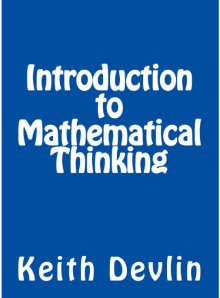
Would you like to learn how to think like a mathematician? Stanford professor (and NPR “Math Guy”) Keith Devlin is teaching a free online course through Coursera. It starts in just a few weeks. I’ve signed up. Will you join us?

The prerequisite is to be taking or have finished high school math. If (like me) you took it so long ago that you can’t quite remember, don’t worry: The focus of the course is not on long-forgotten mathematical procedures, but on “learning to think in a certain (very powerful) way.”

Mathematical thinking is not the same as doing mathematics — at least not as mathematics is typically presented in our school system. School math typically focuses on learning procedures to solve highly stereotyped problems. Professional mathematicians think a certain way to solve real problems, problems that can arise from the everyday world, or from science, or from within mathematics itself.

The key to success in school math is to learn to think inside-the-box. In contrast, a key feature of mathematical thinking is thinking outside-the-box — a valuable ability in today’s world. This course helps to develop that crucial way of thinking.

— Keith Devlin
Introduction to Mathematical Thinking

Continue reading How to Think like a Mathematician

How Crazy Can You Make It?

And here is yet more fun from Education Unboxed. This type of page was always one of my my favorites in Miquon Math.

Update:

Handmade “How Crazy…?” worksheets are wonderful, but if you want something a tad more polished, I created a printable. The first page has a sample number, and the second is blank so that you can fill in any target:

Add an extra degree of freedom: students can fill in the blanks with equivalent and non-equivalent expressions. Draw lines anchoring the ones that are equivalent to the target number, but leave the non-answers floating in space.

Or don’t draw lines. Let the kids create a worksheet for you to solve. After they finish their expressions, can you figure out which ones connect to the target number?

How CRAZY Can You Make It

Princess in the Dungeon Game

Yet more fun from Rosie at Education Unboxed. I found these while looking for videos to use in my PUFM Subtraction post. Rosie says:

This is seriously embarrassing and I debated whether to put this video online or not because this is NOT my normal personality, but my girls made up this game and will play it for over an hour and ask for it repeatedly… so I figured someone out there might be able to use it with their kids, too.

If you know me, please don’t ever ask me to do this in public. I will refuse.

Princess in the Dungeon, Part 1 – Fractions with Cuisenaire Rods

http://vimeo.com/42739095

Continue reading Princess in the Dungeon Game

Multiplication Challenge

Can you explain why the multiplication method in the following video works? How about your upper-elementary or middle school students — can they explain it to you?

Pause the video at 4:30, before he gives the interpretation himself. After you have decided how you would explain it, hit “play” and listen to his explanation.

Continue reading Multiplication Challenge

Thinking (and Teaching) like a Mathematician

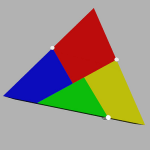
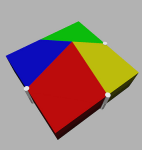
photos by fdecomite via flickr

Most people think that mathematics means working with numbers and that being “good at math” means being able to do (only slower) what any $10 calculator can do. But then, most people think all sorts of silly things, right? That’s what makes “man on the street” interviews so funny.

Numbers are definitely part of math — but only part, and not even the biggest part. And being “good at math” means much more than being able to work with numbers. It means making connections, thinking creatively, seeing familiar things in new ways, asking “Why?” and “What if?” and “Are you sure?”

It means trying something and being willing to fail, then going back and trying something else. Even if your first try succeeded — or maybe, especially if your first try succeeded. Just knowing one way to do something is not, for a mathematician, the same as understanding that something. But the more different ways you know to figure it out, the closer you are to understanding it.

Mathematics is not just memorizing and following rules. If we want to teach real mathematics, we teachers need to learn to think like mathematicians. We need to see math as a mental game, playing with ideas. James Tanton explains:

Continue reading Thinking (and Teaching) like a Mathematician