Substitute Teacher Experiments with Combinatorics


Photo by peigianlong.

Here is a puzzle from Just a Substitute Teacher:

Lesson plan entry: “Hand out worksheet packets and have students staple before starting. They know what to do.”

Sounds simple enough! Four numbered sheets, eight total pages, printed front and back. What could go wrong?

Do you know how many possible combinations four pieces of paper can be arranged for stapling?

Continue reading Substitute Teacher Experiments with Combinatorics

Math Games by Kids

Photo by Mike Licht, NotionsCapital.com.

The cold came back and knocked me flat, but there are compensations. The downtime gave me a chance to browse my overflowing bookmarks folder, and I found something to add to my resource page. Princess Kitten and I enjoyed exploring these games and quizzes from Ambleweb.

Continue reading Math Games by Kids

Subtracting Mixed Numbers: A Cry for Help

Photo by powerbooktrance.

Paraphrased from a homeschool math discussion forum:

“Help me teach fractions! My son can do long subtraction problems that involve borrowing, and he can handle basic fraction math, but problems like 9  -  5 \frac{2}{5} give him a brain freeze. To me, this is an easy problem, but he can’t grasp the concept of borrowing from the whole number. It is even worse when the math book moves on to 10 \frac{1}{4}  -  2 \frac{3}{7} .”

Several homeschooling parents replied to this question, offering advice about various fraction manipulatives that might be used to demonstrate the concept. I am not sure that manipulatives are needed or helpful in this case. The boy seems to have the basic concept of subtraction down, but he gets flustered and is unsure of what to do in the more complicated mixed-number problems.

The mother says, “To me, this is an easy problem” — and that itself is one source of trouble. Too often, we adults (homeschoolers and classroom teachers alike) don’t appreciate how very complicated an operation we are asking our students to perform. A mixed-number calculation like this is an intricate dance that can seem overwhelming to a beginner.

I will go through the calculation one bite at a time, so you can see just how much a student must remember. As you read through the steps, pay attention to your own emotional reaction. Are you starting to feel a bit of brain freeze, too?

Afterward, we’ll discuss how to make the problem simpler…

Continue reading Subtracting Mixed Numbers: A Cry for Help

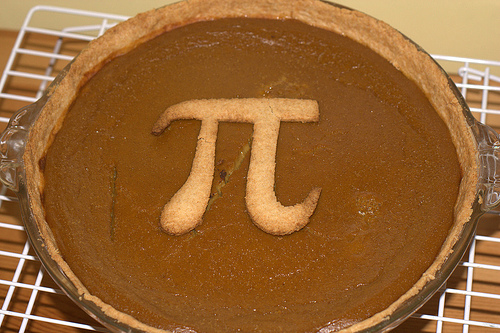
Happy Pi Day II

[Feature photo above by pauladamsmith.]

Now there is an ancient Greek letter,
And I think no other is better.
It isn’t too tall,
It might look very small,
But its digits, they go on forever.

— Scott
Mrs. Mitchell’s Virtual School

Time to Celebrate

Are your students doing anything special for \pi Day? After two months with no significant break, we are going stir crazy. We need a day off — and what better way could we spend it than to play math all afternoon?


If you need ideas, here are some great \pi pages:

Continue reading Happy Pi Day II

Way To Go, Boys!

Math competition
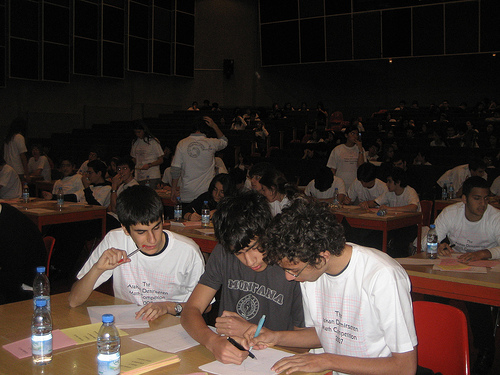
Photo by ccarlstead.

Congratulations, math team! All your hard work paid off, and I hope you enjoyed yourselves thoroughly. Of course, as C. S. Lewis wrote:

…if you do one good deed, your reward usually is to be set to do another and harder and better one.

C. S. Lewis
The Horse and His Boy

Now it’s time to practice for the state level in March. You can find practice problems online at:

Preparation Drills for MATHCOUNTS
or
The “Go Figure!” math challenge
[ACK! MathCounts has re-written their website. The old link is no longer any good, but I haven’t yet found the new location for this game.]

And give the new interactive Countdown Round game a try:

AoPS For The Win!

Continue reading Way To Go, Boys!

2008 Mathematics Game

Are you ready for a challenge? Join us for the 2008 Mathematics Game. Here are the rules:

Use the digits in the year 2008 and the operations +, -, x, ÷, sqrt (square root), ^ (raise to a power), and ! (factorial) — along with parentheses, brackets, or other grouping symbols — to write expressions for the counting numbers 1 through 100.

  • All four digits must be used in each expression.
  • Only the digits 2, 0, 0, 8 may be used.
  • Multi-digit numbers such as 20, 208, or .02 MAY be used this year.
  • The square function may NOT be used.
  • The integer function may NOT be used.

By definition:
0! = 1
[See Dr. Math’s Why does 0 factorial equal 1?]

For this game we will accept the value:
{0}^{0} = 1
[See the Dr. Math FAQ 0 to the 0 power.]

Continue reading 2008 Mathematics Game

Puzzles for the New Year

by Koshyk via flickr

As we all head back to school, here are some interesting calendar puzzles:

  • 2008 is a leap year. Why do leap years happen? If we didn’t add a leap day every so often, would January eventually come in the summer?
  • Today is Thursday. What day of the week will it be exactly one year from today?
  • January 1, 2008, came on a Tuesday. When will be the next year that begins on Tuesday?
  • My birthday (in March) lands on a Monday this year. When is the next year my birthday will come on a Monday? How about YOUR birthday — when is the next time it will happen on the same day of the week as this year?
  • Can you find a pattern in the way dates move from one day of the week to another, year after year?

Continue reading Puzzles for the New Year