What Is Multiplication, Anyway?

At some point during the process of teaching multiplication to our children, we really need to come to terms with this question:

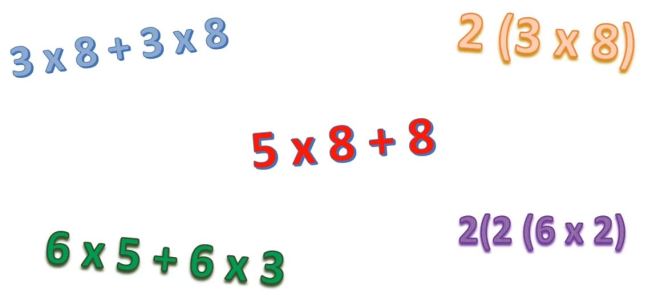
What IS multiplication?

Did your device hide the video? Find it on YouTube here.

“What’s my answer? It’s not one that society’s going to like. Because society expects — demands, even — that mathematics be concrete, real-world, absolute, having definitive answers.

    I can’t give a definitive answer.

      Multiplication manifests itself in different ways. So maybe the word ‘is’ there is just too absolute. And it’s actually at odds with what mathematicians do.

        Mathematicians do attend to real-world, practical scenarios — by stepping away from them, looking at a bigger picture.”

        —James Tanton, What is Multiplication?

        For Further Study

        You may also enjoy these posts from my blog archive:

        Memorizing the Times Table: A Life Skills Approach

        Continuing on my theme of times table facts, here’s the inimitable James Tanton:

        Did your device hide the video? Find it on YouTube here.

        “If our task is to memorize this table, please make it about mathematics — about thinking your way through a challenge, and what can I do to make my life easier.”

        —James Tanton, Making Memorising Multiplication Facts (if one really must) a meaningful Life Skill Lesson

        For Further Study

        You may also enjoy my blog post series about working through the times tables, paying attention to mathematical relationships (and a bit of prealgebra) along the way.

        Times Tables Series

        Click the button to see the whole series. Scroll down to the first post to go through it in order.

        Happy Mathy Hanukkah

        Hiding among all the other winter-themed activity ideas, I found a few posts for those who celebrate the Festival of Lights.

        For More Holiday Math

        CREDITS: Candle photo (top) by Enrique Macias via Unsplash.com.

        Only Three Facts to Memorize

        A comment from a friend got me playing around with multiplication. I found a few videos from some of my favorite math people, so I’ll be sharing over the next few days.

        Here’s one from Sonya Post of Learning Well at Home. Also, Sonya just hosted Playful Math Education Carnival #143, which is well worth your time to explore!

        Did your device hide the video? Find it on YouTube here.

        “When students have to drill multiplication facts, it’s frustrating, unproductive and it makes them hate math. A better way to master the multiplication table is work on the skills that allow students to multiply quickly and efficiently.”

        —Sonya Post, Why We Don’t Drill Multiplication Facts – What We Do Instead

        Doubling and Halving

        Making doubles and halves are a great foundation for all sorts of math.

        Do you ever play the doubling game with your children? One player picks a starting number, and then you take turns doubling it until your mental math skills run out. How far can you go?

        Or try the halving game: One player chooses a starting number, and you take turns cutting it in half. How tiny can you go?

        As Sonya demonstrated, these skills help your child master their multiplication facts. And they are fantastic preparation for exponents and logarithms, too!

        Playful Math Carnival 143 via Learning Well at Home

        Check out the latest carnival of playful math:

        Each monthly Playful Math Education Blog Carnival brings you a great new collection of puzzles, math conversations, teaching tips, and all sorts of mathy fun. It’s like a free online magazine of mathematical adventures, helpful and inspiring no matter when you read them.

        Sonya put together this wonderful collection of mathematical games, art projects, holiday activities, paper crafts (LOTS of snowflakes!), and more.

        She writes:

          “It doesn’t matter where you look, there are always things to count and lots of things to wonder about. How many snowflakes in a snowman? How many points are on a star? How many turkeys do we eat every year? Does anyone actually eat all the fruitcake that is sold each year?
          “Here is Winter and her holidays by the numbers…
          “This was probably my favorite Playful Math Education Blog Carnival to write. There is so much out there to explore that I’m sure I’ve barely scratched the surface.
          “Come back because I’m going to keep adding to this post…”

        —Sonya Post, Carnival #143

        Click Here to Read the Carnival Blog

        Continue reading Playful Math Carnival 143 via Learning Well at Home

        Mathy Christmas Cards

        I always wait too long to put cards in the mail. Maybe these creative beauties will inspire me to get started right away?

        For More Holiday Math

        CREDITS: Reindeer photo (top) by Norman Tsui via Unsplash.com.

        What Are Mixed Numbers?

        I just discovered a fascinating fact: In some places in the world, mixed numbers apparently don’t exist.

        So that made me curious about my blog readers:

        • Did you learn about mixed numbers in school?
        • Do you ever use mixed numbers in daily life?
        • Are your children learning to work with them?

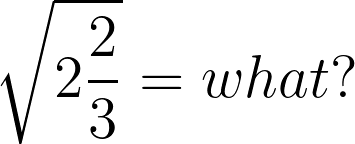
        And if you DO know mixed numbers, can you simplify this mess:

        [If you enjoy dry math humor, the answer is worth the work.]

        Continue reading What Are Mixed Numbers?

        The Principality of Mathematics

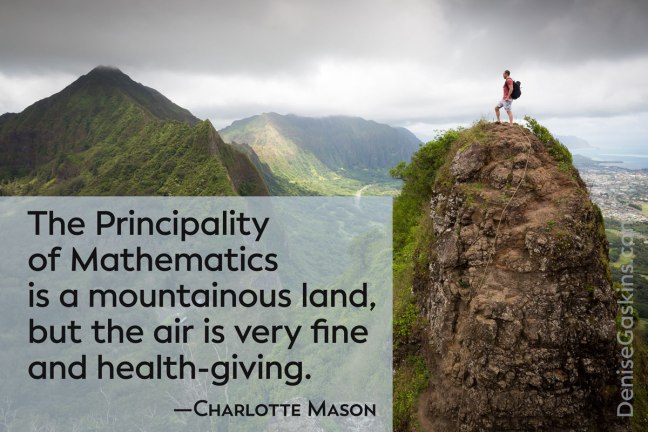
        quotation from Charlotte Mason: The principality of mathematics is a mountainous land, but the air is very fine and health-giving

        Here’s the full quote:

        “The Principality of Mathematics is a mountainous land, but the air is very fine and health-giving, though some people find it too rare for their breathing. People who seek their work or play in this principality find themselves braced by effort and satisfied with truth.”

        — Charlotte Mason, Ourselves

        Charlotte Mason and Math

        Math was not one of Charlotte Mason’s primary interests. She didn’t think or write as deeply about it as she did other subjects.

        She even wrote, “It is unnecessary to exhibit mathematical work done in the P.U.S. as it is on the same lines and reaches the same standard as in other schools.”

        This leaves us modern parents and teachers having to read our own interpretations into her words. It should be no surprise when we come to different conclusions. Someday, perhaps, I’ll publish my own vision for a Charlotte Mason approach to homeschooling math.

        In the meantime, the following articles describe a method that allows even the youngest children to explore the Principality of Mathematics:

        In the years since writing those posts, Sonya and Lacy combined all their ideas into an easy-to-implement program that I think Mason herself would have enjoyed. Here’s my review:

        CREDITS: Quote background photo (top) by Kalen Emsley via Unsplash.com.

        Mathematical Days of Christmas

        Enjoy this bit of seasonal fidgeting from Vi Hart.

        If you don’t understand some of the references, that’s normal! Pick a phrase, Google it, and relish the fun of learning something new.

        Did your device hide the video? Find it on YouTube here.

        For More Holiday Math

        CREDITS: Lamppost photo (top) by Aaron Burden via Unsplash.com.

        Math Advent Calendars for 2020

        Would you like to add some no-preparation-required fun to your math lessons this month?

        Check out these creative mathematical Advent calendars, each featuring one puzzle or activity per day for December 1–24.

        Some of the calendars may show a previous year’s date. (This is 2020 after all!) But the puzzles are evergreen — you can enjoy them anytime.

        For more Advent-math links, visit Colleen Young’s Mathematical Advent Calendars post. And don’t miss my massive blog post Holiday Math Puzzles and Activities for Christmas, Winter Break.