How to Start an Argument: The Monty Hall Problem


[Photo by MontyPython.]

You can get a good argument going in almost any group of people with the infamous Monty Hall problem:

Imagine you are on a TV game show, and the host lets you choose between three closed doors. One of the doors hides a fancy sports car, and if you pick that door, you win the car.

You pick door #1.

The host opens door #3 to reveal a goat. Then he gives you a chance to switch your door for the unopened door #2.

Should you switch?

What if you say you’re going to switch, and then the host offers to give you $5,000 instead of whatever is behind door #2?

Try the game for yourself at the Stay or Switch website.

Continue reading How to Start an Argument: The Monty Hall Problem

Math Clubs, Math Circles, and the Richmond Math Salon

Photo by jaaron via flickr.

If you’ve been thinking of starting a math club, here’s a good model:

People have this notion that math is about getting a right answer, and the testing really emphasizes that notion. And that’s such a bad way to approach math because it makes it scary.

When you look at little kids, they pose their own questions. They say, “Ooooh, what’s bigger than a million?” And they think about things their own way. At school, the teacher poses the questions, and the students answer their questions. Schooling is not a natural environment for learning.

— Sue VanHattum, Math Mama Writes
Richmond Math Salon: A Sweet Sampling

Continue reading Math Clubs, Math Circles, and the Richmond Math Salon

20 Best Math Games and Puzzles

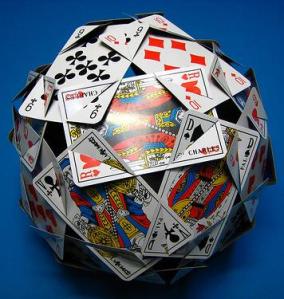
[Photo by fdecomite.]

UPDATE

See the new, expanded games post here:

Original Post

Over the years, Let’s Play Math! blog has grown into a sprawling mess of 480+ posts, which can make it very hard to find the specific math tip you’re looking for. The Archives page is nearly useless, with the articles organized by month of publication.

Therefore, I’ve begun putting together a Best of the Blog page, collecting the all-time favorite blog posts from each category. [It’s done! :D]

And where better to start than with my top hands-on activities?

Skim. Click. Explore. Have fun!

Continue reading 20 Best Math Games and Puzzles

Game: Target Number (or 24)

[Photo by stevendepolo via Flickr (CC BY 2.0).]

Math concepts: addition, subtraction, multiplication, division, powers and roots, factorial, mental math, multi-step thinking
Number of players: any number
Equipment: deck of math cards, pencils and scratch paper, timer (optional)

Set Up

All players must agree on a Target Number for the game. Try to choose a number that has several factors, which means there will be a variety of ways to make it. Traditionally, I start my math club students with a target of 24.

Shuffle the deck, and deal four cards face down to each player. (For larger target numbers, such as 48 or 100, deal five or six cards to each player.) The players must leave the cards face down until everyone is ready. Set the remainder of the deck to one side.

Continue reading Game: Target Number (or 24)

Battlestations!!!

Nerds battle hungry football players who want to eat their giant fractal Dorito creation:

For more details on this video (and photos of the fractal’s construction), check out the Blown Apart Studios page. I’m looking forward to their next project, Nerd High, a musical comedy set in an alternate reality where nerds rule the school and jocks are the outcasts.

2010 Mathematics Game


[Photo by pfala.]

Did you know that playing games is one of the Top 10 Ways To Improve Your Brain Fitness? So slip into your workout clothes and pump up those mental muscles with the 2010 Mathematics Game!

Here are the rules:

Use the digits in the year 2010 to write mathematical expressions for the counting numbers 1 through 100.

  • All four digits must be used in each expression. You may not use any other numbers except 2, 0, 1, and 0.
  • You may use the arithmetic operations +, -, x, ÷, sqrt (square root), ^ (raise to a power), and ! (factorial). You may also use parentheses, brackets, or other grouping symbols.
  • You may use a decimal point to create numbers such as .1, .02, etc.
  • Multi-digit numbers such as 20 or 102 may be used, but preference is given to solutions that avoid them.

Bonus Rule
You may use the overhead-bar (vinculum), dots, or brackets to mark a repeating decimal.

[Note to teachers: This rule is not part of the Math Forum guidelines. It makes a significant difference in the number of possible solutions, however, and it should not be too difficult for high school students or advanced middle schoolers.]

Continue reading 2010 Mathematics Game

Cardstock Geometry Puzzle

While browsing the Kim Komando website for ideas I could use in my blogging class, I followed a rabbit trail through Kim’s video archive. I think we will try this in Math Club next semester:

If the embedded video doesn’t work on your computer, you can find the original here: Unbelievable Paper Transformer.

Update

Simon posted a template for the puzzle at his MathsClass blog.

Quilt: What Can You Do with This?


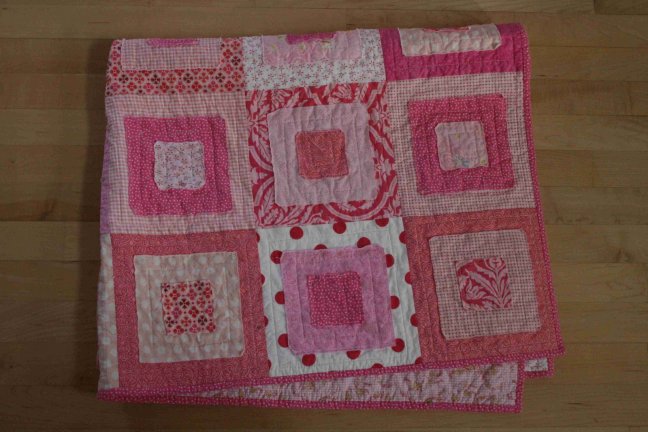
[Ragged Squares Quilt photos used with permission from Crazy Mom Quilts.]

I know other teachers have done math quilts, but I’ve never gotten around to trying it in any of my classes. Still, this image caught my eye and practically begged me to make it into a math lesson for my elementary math club.

I thought of at least two ways I could go with this, but I bet that if we put our brains together, we can come up with even more creative ideas. So here’s the question, ala Dan Meyer:

  • What can you do with this?

How could you use this image as a springboard to doing math? What questions would you ask? What concepts would you try to get across? What would you follow it with? Please comment!

Other photos are available…

Continue reading Quilt: What Can You Do with This?

Tangrams and Other Dissection Puzzles

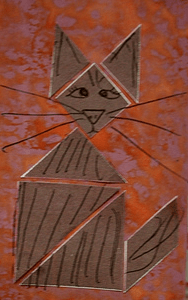
tangram-cat[Photo by jimmiehomeschoolmom.]

One of the things I meant to do with my elementary math class (the one that got canceled due to low enrollment):

And then we would play around with Tangram puzzles, and perhaps make up a few of our own.

Continue reading Tangrams and Other Dissection Puzzles