Holiday Math and More: Playful Math Education Carnival 114

Do you enjoy math? I hope so! If not, the links in this post just may change your mind.

Welcome to the 114th edition of the Math Teachers At Play math education blog carnival — a smorgasbord of articles by bloggers all around the internet who have great ideas for learning, teaching, and playing around with math from preschool to pre-college.

If you would like to jump straight to our featured blog posts, click here to see the Table of Contents.

By the way, I found a cool, semi-self-referential trivia tidbit about our carnival number: 27 − 14 = 114. And if you put 114 dots into a 1←7 Exploding Dots machine, you’ll get the code 222. Pretty neat!

As you scroll through the links below, you find several puzzle graphics from the wonderful Visual Patterns website. Use them as conversation-starters with your kids: What do you notice? How does each pattern grow? For older students: Can you write a formula to describe how each pattern? What will it look at stage 43?

Pattern #7, Trees

A BIT OF FUN

Setting the mood: Enjoy this bit of seasonal fidgeting from Vi Hart (@vihartvihart).

If you don’t understand some of the references, that’s normal! Pick a phrase, Google it, and enjoy the fun of learning something new.


TABLE OF CONTENTS

And now, on to the main attraction: the blog posts. Some articles were submitted by their authors; others were drawn from the immense backlog in my rss reader. If you’d like to skip directly to your area of interest, click one of these links.

Let the mathematical fun begin!

Continue reading Holiday Math and More: Playful Math Education Carnival 114

Check Out These Cool Math Sales

I’ve been following Sonya’s Arithmophobia No More blog for a couple of years, and I love the work she is doing. But this month, she’s teamed up with Lacy at Play, Discover, Learn (another great blog to follow!) to offer a humongous bundle of playful math.

You get math journaling pages, games, creative task cards, thought-provoking worksheets, and video training resources to help you build your child’s understanding of math from arithmetic to early algebra. Wow!

These activities are perfect for homeschooling families or anyone looking to supplement their child’s current math curriculum with effective discovery-based activities. If you’ve ever wondered what to do with those Cuisenaire rods you picked up on sale way back when, this bundle is for you.

I’m so looking forward to using some of these ideas with my elementary homeschool co-op kids next year!

Sale price is $30 from December 2-15.

Cuisenaire Rod Activities Blowout Bundle

But Wait, There’s More

If you’ve been reading my blog for very long, you’ve probably seen how much I love the blog, books, and classes available from the Natural Math folks.

Their newest book is just off the presses — Funville Adventures, a math adventure chapter book.

And until December 20, they’re having a holiday sale. Make your own bundle of any Natural Math books. Playful algebra, calculus for 5-year-olds, inquiry problems and more: Great deal!

Natural Math Book Sale

Stock Up on My Playful Math Books

Finally, if you’ve been wanting to pick up a paperback copy of Let’s Play Math or some of my game books, or maybe a set of dot-grid math journals, I’m currently offering a discount on bulk orders.

Bundle ANY assortment of titles. Stock up on books for your family, friends, or homeschool group.

  • 2–4 books: 15% discount off retail prices
  • 5–9 books: 25% discount
  • 10–19 books: 35% discount
  • 20+ books: 35% discount, and free Continental U.S. standard shipping or the equivalent discount off other shipping options

Bulk Order Playful Math Paperbacks

(US customers only: We’re sorry we can’t offer bulk discounts for our international readers, but the complexities of international duties and tax laws are too much for this very small family business.)

Do You Know of Any Math Deals?

Apollonian greetings from my homeschool co-op kids, and best wishes for a grace-filled holiday season.

If you’ve seen a great deal or holiday price on a math resource you love, please share!

Add your deal to the comment section below, so we can all take advantage of the math joy this season.

How to Succeed in Math: Answer-Getting vs. Problem-Solving

You want your child to succeed in math because it opens so many doors in the future.

But kids have a short-term perspective. They don’t really care about the future. They care about getting through tonight’s homework and moving on to something more interesting.

So how can you help your child learn math?

When kids face a difficult math problem, their attitude can make all the difference. Not so much their “I hate homework!” attitude, but their mathematical worldview.

Does your child see math as answer-getting? Or as problem-solving?

Answer-getting asks “What is the answer?”, decides whether it is right, and then goes on to the next question.

Problem-solving asks “Why do you say that?” and listens for the explanation.

Problem-solving is not really interested in “right” or “wrong”—it cares more about “makes sense” or “needs justification.”

Homeschool Memories

In our quarter-century-plus of homeschooling, my children and I worked our way through a lot of math problems. But often, we didn’t bother to take the calculation all the way to the end.

Why didn’t I care whether my kids found the answer?

Because the thing that intrigued me about math was the web of interrelated ideas we discovered along the way:

  • How can we recognize this type of problem?
  • What other problems are related to it, and how can they help us understand this one? Or can this problem help us figure out those others?
  • What could we do if we had never seen a problem like this one before? How would we reason it out?
  • Why does the formula work? Where did it come from, and how is it related to basic principles?
  • What is the easiest or most efficient way to manipulative the numbers? Does this help us see more of the patterns and connections within our number system?
  • Is there another way to approach the problem? How many different ways can we think of? Which way do we like best, and why?

What Do You think?

How did you learn math? Did your school experience focus on answer-getting or problem-solving?

How can we help our children learn to think their way through math problems?

I’d love to hear from you! Please share your opinions in the Comments section below.

CREDITS: “Math Phobia” photo by Jimmie (blog post title added) via Flickr (CC BY 2.0). Phil Daro video by SERP Media (the Strategic Education Research Partnership) via Vimeo.

Mindset for Learning Math

Playing with a new image editor, I came across this Winston Churchill quote. What a great description of how it feels to learn math!

If you have a student who struggles with math or is suffering from a loss of enthusiasm, check out Jo Boaler’s free online course on developing a mathematical mindset:

Or explore some of the playful activity ideas for all ages in her Week of Inspirational Math.

Rabbit Trails and Fibonacci Poetry

Homeschool Memories…

Well, I hadn’t planned on spending my day that way. But one of the great things about homeschooling is the freedom to follow rabbit trails.

While browsing the Carnival of Homeschooling, I found a link to Farm School blog’s article Fib Foolery, which sent me to Gotta Book for his articles The Fib and More Fibbery (read the comments on both threads, but be warned that some are crude) and several other posts, all of which set me off on a morning of poetic fun.

A “Fib” is a Fibonacci poem. It’s based on syllable count, like a haiku, but the lines follow the Fibonacci counting series: 1, 1, 2, 3, 5, 8… Each number is the sum of the previous two numbers.

I knew what I was going to share at our Tuesday Teatime and Poetry Reading that afternoon.

Continue reading Rabbit Trails and Fibonacci Poetry

There Ain’t No Free Candy

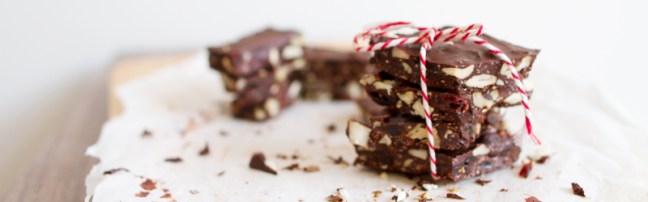
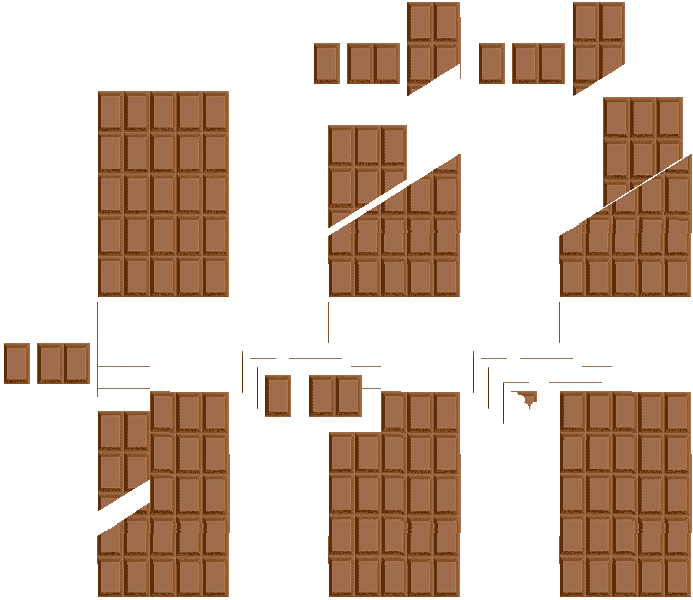
Ah, the infinite chocolate bar. If only it could work in real life! But can your children find the mistake? Where does the extra chocolate come from?

Here’s a hint: It’s related to this classic brainteaser. And here’s a video from Christopher Danielson (talkingmathwithkids.com), showing how the chocolate bar dissection really works.

Happy munchings!

CREDITS: Feature photo (top) by Yoori Koo via Unsplash. “Hershey Bar Math” video by Christopher Danielson via YouTube. The infinite chocolate gif went viral long ago, and I have no idea who was the original artist.

Playful Math Education Carnival 106 with Math Art

Do you enjoy math? I hope so! If not, browsing this post just may change your mind.

Welcome to the 106th edition of the Math Teachers At Play math education blog carnival — a smorgasbord of links to bloggers all around the internet who have great ideas for learning, teaching, and playing around with math from preschool to pre-college. Let the mathematical fun begin!

By tradition, we start the carnival with a puzzle in honor of our 106th edition. But if you would like to jump straight to our featured blog posts, click here to see the Table of Contents.

Try This Puzzle

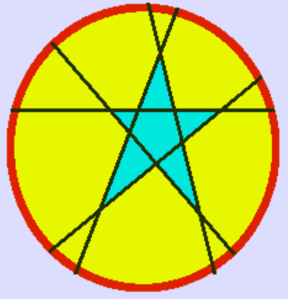
If you slice a pizza with a lightsaber, you’ll make straight cuts all the way across. Slice it once, and you get two pieces.

If you slice it five times, you’ll get a maximum of sixteen pieces. (And if you’re lucky you might get a star!)

  • How many times would you have to slice the pizza to get 106 pieces?

Click here for all the mathy goodness!

Dot Grid Doodling

What can you DO with a page full of dots?

Yesterday, I mentioned my new series of paperback dot grid notebooks, and I promised to share a few ideas for mathematical doodling.

But first, let me share my new dot-grid journals for kids. Aren’t they pretty?

Click Here for More Information

Doodling gives our minds a chance to relax, wander, and come back to our work refreshed. And though it goes against intuition, doodling can help us remember more of what we learn.

Math doodles let us experiment with geometric shapes and symmetries. We can feel our way into math ideas gradually, through informal play. Through doodles, our students will explore a wide range of mathematical structures and relationships.

Our own school experiences can make it hard for us to teach. What we never learned in school was the concept of playing around with math, allowing ideas to “percolate,” so to speak, before mastery occurs, and that process may take time.

—Julie Brennan

I like to doodle on dotty grid paper, like the pages in my math journals, but there’s No Purchase Necessary! You can design your own printable dot page at Incompetech’s PDF generator.

Patterns in Shape and Angle

To make a faceted mathematical gemstone, start with any shape you like. Then build other shapes around it. What do you notice? Does your pattern grow outward from its center? Or flow around the corner of your page? How is each layer similar, and how is it different?

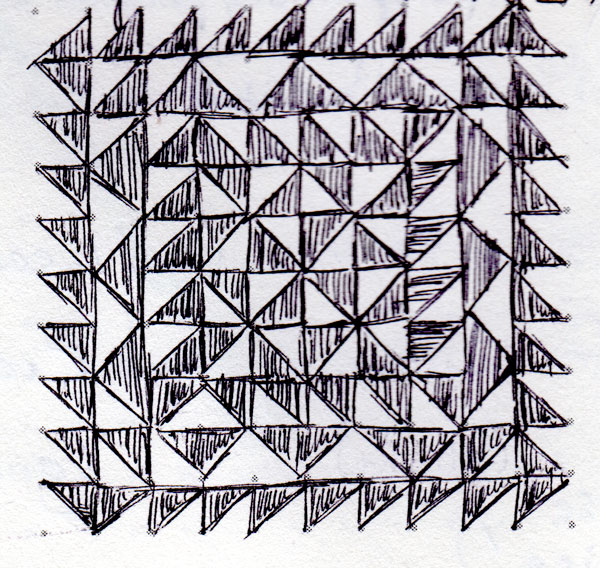
Arbitrary constraints can lead to mathematically interesting doodles. For instance, create a design out of 45-45-90 triangles by coloring exactly half of every grid square. How many variations can you find?

Symmetry Challenge

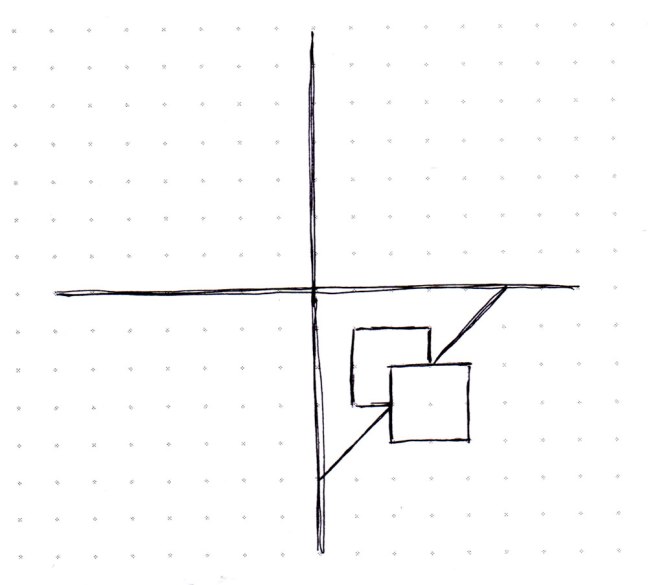
Play a symmetry puzzle game. Draw a line of symmetry and fill in part of the design. Then trade with a partner to finish each other’s doodles.

Make more complex symmetry puzzles with additional reflection lines.

Math Doodle Links

  • Who can talk about mathematical doodling without mentioning Vi Hart? If you’ve never seen her “Doodling in Math Class” video series, you’re in for a treat!
  • See if you can draw a rotational-symmetry design, like Don’s “Order 4” graphs.
  • Or experiment with the more flexible rules in John’s “Knot Fun” lesson.
  • And my latest obsession: the “ultimate” tutorial series on Celtic Knotwork, which explores the link between knots and their underlying graphs.
My favorite knot doodle so far.
Inspirations: A Recreational Mathematics Journal
Reflections: A Math Teacher’s Journal
Explorations: A Math Student’s Journal
Contemplations: A Homeschooler’s Journal

Before you start doodling: How to Break In Your New Math Journal.

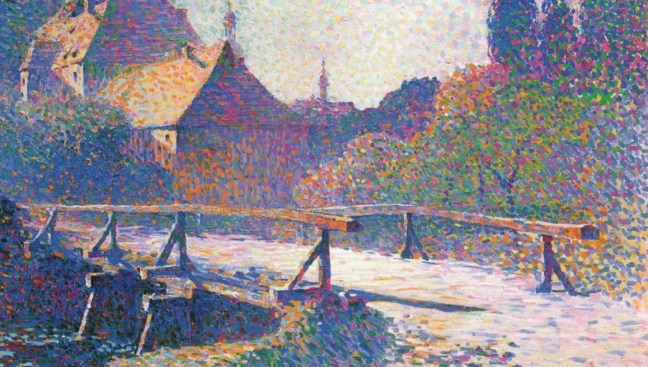
Feature photo (top): Sommermorgen (Alte Holzbrücke in Pretzfeld) by Curt Herrmann, via Wikimedia Commons. [Public domain]

Math Inspirations: Why Study Mathematics?

why-study-math

What teacher hasn’t heard a student complain, “When am I ever going to have to use this?” Didn’t most of us ask it ourselves, once upon a time?

And unless we choose a math-intensive career like engineering, the truth is that after we leave school, most of us will never again use most of the math we learned.

But if math beyond arithmetic isn’t all that useful, then what’s the point?

If you or your student is singing the “Higher Math Blues,” here are some quotations that may cheer you up — or at least give you the strength of vision to keep on slogging.

We Study Mathematics…

To Understand Creation

I don’t want to convince you that mathematics is useful. It is, but utility is not the only criterion for value to humanity. Above all, I want to convince you that mathematics is beautiful, surprising, enjoyable, and interesting. In fact, mathematics is the closest that we humans get to true magic. How else to describe the patterns in our heads that — by some mysterious agency — capture patterns of the universe around us? Mathematics connects ideas that otherwise seem totally unrelated, revealing deep similarities that subsequently show up in nature.

— Ian Stewart
The Magical Maze

That vast book which stands forever open before our eyes, the universe, cannot be read until we have learnt the language in which it is written. It is written in mathematical language, and the letters are triangles, circles, and other geometrical figures, without which means it is humanly impossible to comprehend a single word.

— Galileo Galilei
quoted by Clifford Pickover, A Passion for Mathematics

To Train Our Minds

The investigation of mathematical truths accustoms the mind to method and correctness in reasoning, and is an employment peculiarly worthy of rational beings.

— George Washington
quoted by William Dunham, The Mathematical Universe

I told myself, “Lincoln, you can never make a lawyer if you do not understand what demonstrate means.” So I left my situation in Springfield, went home to my father’s house, and stayed there till I could give any proposition in the six books of Euclid at sight. I then found out what “demonstrate” means, and went back to my law studies.

— Abraham Lincoln
quoted by William Dunham, The Mathematical Universe

To Understand History

In most sciences, one generation tears down what another has built, and what one has established another undoes. In mathematics alone, each generation adds a new story to the old structure.

— Herman Henkel
quoted by Noah benShea, Great Quotes to Inspire Great Teachers

Biographical history, as taught in our public schools, is still largely a history of boneheads: ridiculous kings and queens, paranoid political leaders, compulsive voyagers, ignorant generals — the flotsam and jetsam of historical currents. The men who radically altered history, the great scientists and mathematicians, are seldom mentioned, if at all.

— Martin Gardner
quoted by G. Simmons, Calculus Gems

I will not go so far as to say that constructing a history of thought without profound study of mathematical ideas is like omitting Hamlet from the play named after him. But it is certainly analogous to cutting out the part of Ophelia. For Ophelia is quite essential to the play, she is very charming. . . and a little mad.

— Alfred North Whitehead
quoted in The Viking Book of Aphorisms

To Appreciate the Beauty

The mathematician does not study pure mathematics because it is useful, he studies it because he delights in it, and he delights in it because it is beautiful.

— Henri Poincaré
quoted by Theoni Pappas, More Joy of Mathematics

A mathematician, like a painter or poet, is a maker of patterns. If his patterns are more permanent than theirs, it is because they are made with ideas. The mathematician’s patterns, like the painter’s or the poet’s, must be beautiful. The ideas, like the colors or the words, must fit together in a harmonious way. Beauty is the first test: there is no permanent place in this world for ugly mathematics.

— Godfrey H. Hardy
A Mathematician’s Apology

And Most of All, to Play

Mathematics is a world created by the mind of men, and mathematicians are people who devote their lives to what seems to me a wonderful kind of play!

Constance Reid

At age eleven, I began Euclid, with my brother as tutor. This was one of the great events of my life, as dazzling as first love. I had not imagined there was anything so delicious in the world.

— Bertrand Russell
The Autobiography of Bertrand Russell

I love mathematics … principally because it is beautiful, because man has breathed his spirit of play into it, and because it has given him his greatest game — the encompassing of the infinite.

Rózsa Péter
quoted by Rosemary Schmalz, Out of the Mouths of Mathematicians

Did you enjoy these? You can find plenty more on my Math & Education Quotations page.

  • I would LOVE to hear YOUR favorite mathematics, education, or inspirational quote. Please share in the Comments section below!

CREDITS: Never Ending Math Problem photo (above) by Danny (blog post title added) via Flickr (CC BY 2.0).

My Favorite Math Games

Take a break from textbook math and enjoy yourself!

I like to use games as a warm-up with my co-op math classes. Some homeschoolers make every Friday a game day, and some turn gaming into a family lifestyle.

favorite-math-games

“Playing games with your kids offers a host of educational benefits, plus you build relationships and make memories. I am constantly amazed by the amount of learning that happens when I sit down to play games with my children.”

—Caitlin Fitzpatrick Curley
Gameschool Challenge

Family Games for All Ages

“Games put children in exactly the right frame of mind for learning difficult things. Children relax when they play — and they concentrate. They don’t mind repeating certain facts or procedures over and over, if repetition is part of the game.”

Peggy Kaye
Games for Math

Accessible to Young Children

“Coming back from winter break can be hard. Everyone is sleepy, unfocused, and daydreaming of the holiday gifts that await them at home after school. And that’s just the teachers!”

—Andrew Gael
Beat the Back to School Blues…Play a Math Game

For Elementary Students

“If you play these games and your child learns only that hard mental effort can be fun, you will have taught something invaluable.”

Peggy Kaye
Games for Math

Middle School to Adult

“Mathematics is mental play, the essence of creative problem solving. This is the truth we need to impart to our children, more important than fractions or decimals or even the times tables. Math is a game, playing with ideas.”

—Denise Gaskins
Let’s Play Math: How Families Can Learn Math Together—and Enjoy It

Your Turn: What Are Your Favorite Games?

They don’t have to be math! Please share in the comment section below!

 
* * *

This blog is reader-supported.

If you’d like to help fund the blog on an on-going basis, then please join me on Patreon for mathy inspiration, tips, and an ever-growing archive of printable activities.

If you liked this post, and want to show your one-time appreciation, the place to do that is PayPal: paypal.me/DeniseGaskinsMath. If you go that route, please include your email address in the notes section, so I can say thank you.

Which I am going to say right now. Thank you!

“My Favorite Math Games” copyright © 2017 by Denise Gaskins. Image at the top of the post copyright © Denise Gaskins.