Subtracting Mixed Numbers: A Cry for Help

Photo by powerbooktrance.

Paraphrased from a homeschool math discussion forum:

“Help me teach fractions! My son can do long subtraction problems that involve borrowing, and he can handle basic fraction math, but problems like 9  -  5 \frac{2}{5} give him a brain freeze. To me, this is an easy problem, but he can’t grasp the concept of borrowing from the whole number. It is even worse when the math book moves on to 10 \frac{1}{4}  -  2 \frac{3}{7} .”

Several homeschooling parents replied to this question, offering advice about various fraction manipulatives that might be used to demonstrate the concept. I am not sure that manipulatives are needed or helpful in this case. The boy seems to have the basic concept of subtraction down, but he gets flustered and is unsure of what to do in the more complicated mixed-number problems.

The mother says, “To me, this is an easy problem” — and that itself is one source of trouble. Too often, we adults (homeschoolers and classroom teachers alike) don’t appreciate how very complicated an operation we are asking our students to perform. A mixed-number calculation like this is an intricate dance that can seem overwhelming to a beginner.

I will go through the calculation one bite at a time, so you can see just how much a student must remember. As you read through the steps, pay attention to your own emotional reaction. Are you starting to feel a bit of brain freeze, too?

Afterward, we’ll discuss how to make the problem simpler…

Continue reading Subtracting Mixed Numbers: A Cry for Help

Answers to Alex’s and Leon’s Puzzles

Remember the Math Adventurer’s Rule: Figure it out for yourself! Whenever I give a problem in an Alexandria Jones story, I will try to post the answer soon afterward. But don’t peek! If I tell you the answer, you miss out on the fun of solving the puzzle. So if you haven’t worked these problems yet, go back to the original posts. Figure them out for yourself — and then check the answers just to prove that you got them right.

Leonhard’s block puzzles

Alex’s & Leon’s homeschool puzzle

Continue reading Answers to Alex’s and Leon’s Puzzles

Alex’s & Leon’s Homeschool Puzzle

While checking out the book table after a homeschool group meeting, Maria Jones glanced up to see her children laughing with some kids she did not recognize. Driving home, she asked about the new family, but Alex and Leon had been too busy exchanging silly stories to even ask the strangers’ names.

“Well,” Leon said, “the boy told me he has twice as many sisters as brothers.”

No way!” said Alex. “The girl told me that she has the same number of brothers and sisters.”

How can that be?

Continue reading Alex’s & Leon’s Homeschool Puzzle

Leonhard’s Block Puzzles

Leon’s wooden block puzzle Leonhard Jones is Alexandria Jones’s younger brother. He enjoys woodworking, and he cut a wooden cube into 8 smaller blocks to make himself a puzzle.

Puzzle #1

Leon painted the 8 blocks with his two favorite colors: red and forest green. When he was finished, Leon could put the blocks together into a red cube, or he could switch them around to make a green cube.

How did Leon paint his blocks?

Continue reading Leonhard’s Block Puzzles

Egyptian Fractions: The Answer Sheet

Remember the Math Adventurer’s Rule: Figure it out for yourself! Whenever I give a problem in an Alexandria Jones story, I will try to post the answer (relatively) soon afterward. But don’t peek! If I tell you the answer, you miss out on the fun of solving the puzzle. So if you haven’t worked these problems yet, go back to the original post. Figure them out for yourself — and then check the answers just to prove that you got them right.


The Secret of Egyptian Fractions

Alex made a poster of Egyptian-style fractions, from 1/2 to 9/10. Many of the fractions were easy. She knew that…

\frac{5}{10}  = \frac{4}{8}  = \frac{3}{6}  = \frac{2}{4}  = \frac{1}{2}

Therefore, as soon as she figured out one fraction, she had the answer to all of its equivalents.

She had the most trouble with the 7ths and 9ths. She tried converting these to other fractions that were easier to work with. For example, 28 has more factors than 7, making 28ths easier to break up into other fractions with one in the numerator.

Continue reading Egyptian Fractions: The Answer Sheet

Way To Go, Boys!

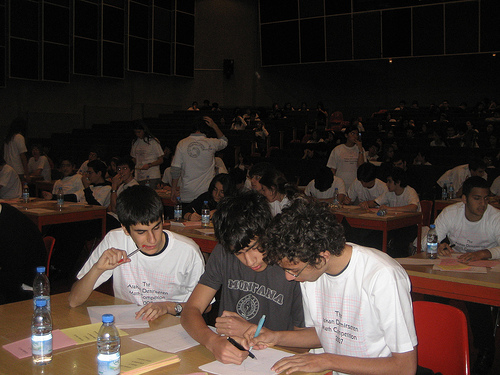
Math competition
Photo by ccarlstead.

Congratulations, math team! All your hard work paid off, and I hope you enjoyed yourselves thoroughly. Of course, as C. S. Lewis wrote:

…if you do one good deed, your reward usually is to be set to do another and harder and better one.

C. S. Lewis
The Horse and His Boy

Now it’s time to practice for the state level in March. You can find practice problems online at:

Preparation Drills for MATHCOUNTS
or
The “Go Figure!” math challenge
[ACK! MathCounts has re-written their website. The old link is no longer any good, but I haven’t yet found the new location for this game.]

And give the new interactive Countdown Round game a try:

AoPS For The Win!

Continue reading Way To Go, Boys!

The Secret of Egyptian Fractions

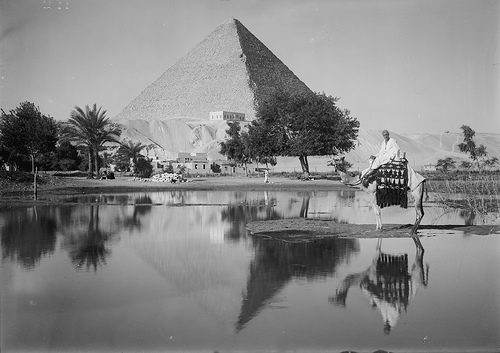
Photo from Library of Congress via pingnews.

Archaeology professor Dr. Fibonacci Jones came home from a long day of lecturing and office work. Stepping inside the front door, he held up a shiny silver disk.

“Ta-da!” he said.

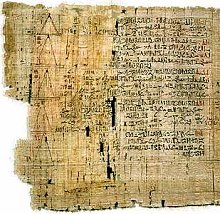
Rhind papyrus

“All right!” said his daughter Alexandria. “The photos are here.”

They had to chase Alex’s brother Leon off the computer so they could view the images on the CD, but that wasn’t hard. He wanted to see the artifacts, too. Alex recognized several of the items they had dug up from the Egyptian scribe’s burial plot: the wooden palette, some clay pots, and of course the embalmed body.

Then came several close-up pictures of writing on papyrus.

Photo from MathsNet.net.

How to Write Egyptian Fractions

“I remember how to read the Egyptian numbers,” Alex said, “but what are these marks above them?”

Dr. Jones nodded. “I thought you would catch that. Those are fractions. The scribe places an open mouth, which is the hieroglyph ‘r’, over a number to make its reciprocal.”

“I know that word,” Leon said. “It means one over the number. Like, the reciprocal of 12 is 1/12, right?”

“That is right. 1/12 would be written as…”

The Rest of the Story

As I transcribed this article from my old math newsletter, I realized that it would require more graphics than I was willing to construct. LaTex does not handle Egyptian hieroglyphs — or at least, I don’t know how to make it do so. Instead, I decided to scan the newsletter pages and give them to you as a pdf file:

Right-click and choose “Save” to download:

The file includes a student worksheet for Egyptian fractions from 1/2 to 9/10.

Egyptian Fractions: The Answer Sheet

The answers are now posted.

To Be Continued…

Read all the posts from the January/February 1999 issue of my Mathematical Adventures of Alexandria Jones newsletter.

The Game of Algebra

NFL football
Photo by velo_city.

My pre-algebra class hit the topic of equations just as the NFL season moved into the playoffs. The result was this series of class notes called “The Game of Algebra.”

We used the Singapore Math NEM 1 textbook, which is full of example problems and quality exercises. These notes simply introduce or review the main concepts and vocabulary in a less-textbooky way.

I hope you find them useful.

Continue reading The Game of Algebra