Visualizing Word Problems with Bar Model Diagrams

A friend emailed me, frustrated with her child’s math lesson on bar diagrams: “Why do they have to make it so complicated? Why can’t we just solve the blasted problem?”

I told her bar models themselves are not the goal. The real question for parents and teachers is:

  • What can you do when your child is stumped by a math word problem?

To solve word problems, students must be able to read and understand what is written. They need to visualize this information in a way that will help them translate it into a mathematical expression.

visualizing-word-problems

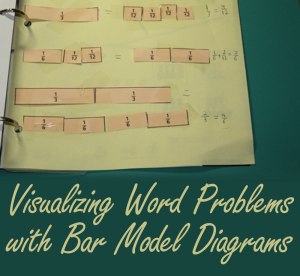
Bar model diagrams are one very useful tool to aid this visualization. These pictures model the word problem in a way that makes the solution appear almost like magic.

It is a trick well worth learning, no matter which math program you use.

Visualization

https://www.youtube.com/watch?v=HKsYDzQK8Zw

“Visualization is the brain’s ability to see beyond what the eyes can see, and we can develop visualization in many ways.”

The Bar Model Explained

https://www.youtube.com/watch?v=I6Ipio8JntU

“A bar model is a way to represent a situation in a word problem using diagrams — in particular, using rectangles.”

https://www.youtube.com/watch?v=i7LAHc1qvig

“This is one of the ideas that children learn in mathematics: the use of diagrams to represent quantities, especially quantities which are unknown.”

Word Problems from Literature

I’ve written a series of blog posts that explain bar model diagrams from the most basic through to solving multistep word problems. Check them out:

I’ve started working on a book about bar model diagrams, and I’d love to hear your input. Have you tried using them? Do they help your children? What questions do you have?

Update: My New Book

You can help prevent math anxiety by giving your children the mental tools they need to conquer the toughest story problems.

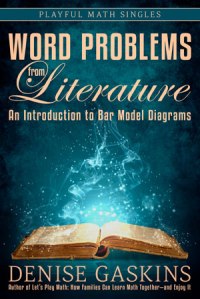
Check out Word Problems from Literature: An Introduction to Bar Model Diagrams—now available at all your favorite online bookstores!

And there’s a Student Workbook, too.

CREDITS: Videos and quotations from Dr. Yeap Ban Har’s YouTube channel. “Girl doing homework” photo (top) by ND Strupler and “math notebooking equal fractions” by Jimmie via Flickr (CC BY 2.0).

My Favorite Math Games

Take a break from textbook math and enjoy yourself!

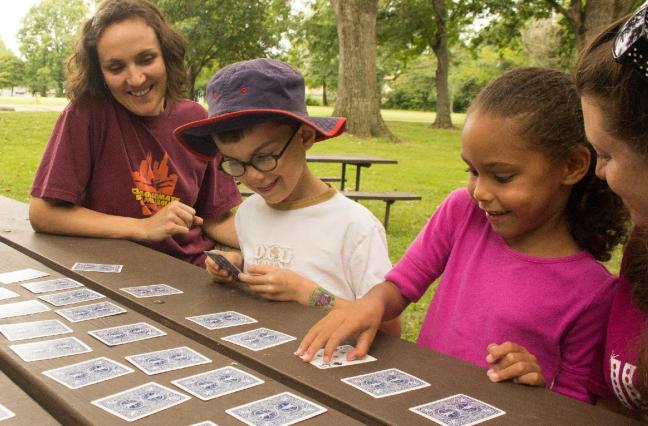
I like to use games as a warm-up with my co-op math classes. Some homeschoolers make every Friday a game day, and some turn gaming into a family lifestyle.

favorite-math-games

“Playing games with your kids offers a host of educational benefits, plus you build relationships and make memories. I am constantly amazed by the amount of learning that happens when I sit down to play games with my children.”

—Caitlin Fitzpatrick Curley
Gameschool Challenge

Family Games for All Ages

“Games put children in exactly the right frame of mind for learning difficult things. Children relax when they play — and they concentrate. They don’t mind repeating certain facts or procedures over and over, if repetition is part of the game.”

Peggy Kaye
Games for Math

Accessible to Young Children

“Coming back from winter break can be hard. Everyone is sleepy, unfocused, and daydreaming of the holiday gifts that await them at home after school. And that’s just the teachers!”

—Andrew Gael
Beat the Back to School Blues…Play a Math Game

For Elementary Students

“If you play these games and your child learns only that hard mental effort can be fun, you will have taught something invaluable.”

Peggy Kaye
Games for Math

Middle School to Adult

“Mathematics is mental play, the essence of creative problem solving. This is the truth we need to impart to our children, more important than fractions or decimals or even the times tables. Math is a game, playing with ideas.”

—Denise Gaskins
Let’s Play Math: How Families Can Learn Math Together—and Enjoy It

Your Turn: What Are Your Favorite Games?

They don’t have to be math! Please share in the comment section below!

 
* * *

This blog is reader-supported.

If you’d like to help fund the blog on an on-going basis, then please join me on Patreon for mathy inspiration, tips, and an ever-growing archive of printable activities.

If you liked this post, and want to show your one-time appreciation, the place to do that is PayPal: paypal.me/DeniseGaskinsMath. If you go that route, please include your email address in the notes section, so I can say thank you.

Which I am going to say right now. Thank you!

“My Favorite Math Games” copyright © 2017 by Denise Gaskins. Image at the top of the post copyright © Denise Gaskins.

New Book: Multiplication & Fraction Games

It’s here! My long-awaited upper-elementary Math You Can Play games book has finally hit the online bookstores.

Multiplication & Fractions features 25 kid-tested games, offering a variety of challenges for school-age students. Children master several math models that provide a sturdy foundation for understanding multiplication and fractions. The games feature times table facts and more advanced concepts such as division, fractions, decimals, and multistep mental math.

Click here to find Multiplication & Fractions at your favorite bookstore.

Multiplication & Fraction Games
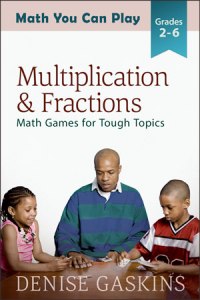
multfrac-300Maybe you never really understood what multiplication means or what fractions are? As long as you start with an open mind and are willing to engage playfully, the activities in the book can help you as you help your kids.
Anecdotally, these two areas are the first major stumbling point for students in their math studies. The sequencing in the book will help kids develop a strong foundation.
Kids (and parents!) find these games fun. I’ve been field testing math games for the last 18 months and keep seeing how engaged kids get when playing math games.

— Joshua Greene
Multiplication & Fractions Math Games from Denise Gaskins (a review)

Chapters include:

  • Mathematical Models: Learn the basic pictures that help support your child’s comprehension.
  • Conquer the Times Tables: Enjoy practicing the math facts until correct answers become automatic.
  • Mixed Operations: Give mental muscles a workout with games that require number skills and logical thinking.
  • Fractions and Decimals: Master equivalent fractions, work with decimal place value, and multiply fractions and decimal numbers.

If you are a parent, these games provide opportunities to enjoy quality time with your children. If you are a classroom teacher, use the games as warm-ups and learning center activities or for a relaxing review day at the end of a term. If you are a tutor or homeschooler, make games a regular feature in your lesson plans to build your students’ mental math skills.

So what are you waiting for? Clear off a table, grab a deck of cards, and let’s play some math!

Check It Out

It starts with models that are visual explanations of the concepts. Gaskins also breaks learning these concepts into comfortable steps that emphasize patterns and relationships, the real ideas that are behind properly understanding multiplication and fractions (indeed, math generally).
The sequence of games in each section starts by building familiarity and then fluency (speed) to solidify all of that work.

— Joshua Greene
Multiplication & Fractions Math Games from Denise Gaskins (a review)

Multiplication & Fraction Printables
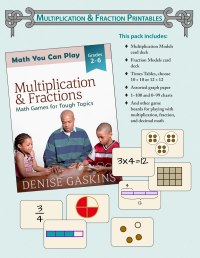
Multiplication & Fraction Printables

Most of the Math You Can Play games use materials you already have around the house, such as playing cards or dice. But this book introduces multiplication and fractions with several games using two special mathematical model card decks.

Click here to download the Multiplication & Fraction Printables, featuring all the math model cards, hundred charts, and game boards you will need for any game in the book.


The Value of Math Games

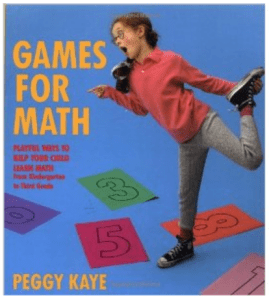
From Peggy Kaye’s classic book Games for Math:

Kaye-Games4Math

“Games put children in exactly the right frame of mind for learning difficult things.

“Children relax when they play — and they concentrate. They don’t mind repeating certain facts or procedures over and over, if repetition is part of the game.

“Children throw themselves into playing games the way they never throw themselves into filling out workbook pages.

“The games solidify the achievements of children who are already good at math, and they shore up children who need shoring up. They teach or reinforce many of the skills that a formal curriculum teaches, plus one skill that formal teaching sometimes leaves out — the skill of having fun with math, of thinking hard and enjoying it.

“If you play these games and your child learns only that hard mental effort can be fun, you will have taught something invaluable.”

Peggy Kaye
Games for Math

Sample Peggy’s Games for Math

 
* * *

This blog is reader-supported.

If you’d like to help fund the blog on an on-going basis, then please join me on Patreon for mathy inspiration, tips, and an ever-growing archive of printable activities.

If you liked this post, and want to show your one-time appreciation, the place to do that is PayPal: paypal.me/DeniseGaskinsMath. If you go that route, please include your email address in the notes section, so I can say thank you.

Which I am going to say right now. Thank you!

“The Value of Math Games” copyright © 2016 by Denise Gaskins.

Making Sense of Arithmetic

Homeschoolers have an advantage in teaching math: As our students grow, our own understanding of math grows with them because we see how the ideas build on each other.

This is especially true for those of us with large families. We pass through the progression of concepts with each student, and every pass lays down another layer in our own minds.

If you’d like to short-cut that process, check out Graham Fletcher’s Making Sense of Elementary Math video series. He’ll walk you through the topics, showing how manipulatives help build early concepts and gradually give way to abstract calculations.

“Understanding the vertical progression of mathematics is really important in the conceptual development of everyone’s understanding. This whole Making Sense Series has truly forced me to be a better teacher.”

— Graham Fletcher

Continue reading Making Sense of Arithmetic

Join the Fun: Math & Magic Virtual Book Club

Math-Magic-WonderlandEleven weeks of mathematical playtime kicks off this week over at Learners in Bloom blog.

Each week, we’ll be playing with the math, language, and logic topics found in a single chapter. I’ll be posting ideas for extension activities, videos demonstrating the concepts for the week, and additional resources. I’m really excited for the opportunity to share all the extra ideas that have been floating around my brain which I didn’t have room to include in the book (as in Marco Polo’s famous words: “I did not tell half of what I saw.”)

— Lilac Mohr

Here’s a Quick Taste of Week One

This Week’s Activities

Lilac’s blog post includes a full schedule for the eleven-week book club, featuring plenty of classic math puzzlers to play with. Here are the topics for this week.

  • Read Chapter 1: Mrs. Magpie’s Manual
  • Alliteration
  • Memorizing digits of Pi
  • Palindromes
  • Calculating your age on other planets

It looks like a lot of fun. I highly recommend the book (read my review), and I’m sure you and your children will enjoy discovering math and magic with Lulu and Elizabeth.

Check it out: Math & Magic in Wonderland Virtual Book Club, Week One.

 
* * *

This blog is reader-supported.

If you’d like to help fund the blog on an on-going basis, then please join me on Patreon for mathy inspiration, tips, and an ever-growing archive of printable activities.

If you liked this post, and want to show your one-time appreciation, the place to do that is PayPal: paypal.me/DeniseGaskinsMath. If you go that route, please include your email address in the notes section, so I can say thank you.

Which I am going to say right now. Thank you!

“Join the Fun: Math & Magic Virtual Book Club” copyright © 2016 by Denise Gaskins.

FAQ: Trouble Finding the Right Math Program

“I can’t find a home school math program my son likes. We’ve tried Singapore Math, Right Start, Saxon, and Math Mammoth. We subscribed to a month of IXL Math to keep him in practice, but he hates that, too. I know I shouldn’t have changed so many times, but this was our first year of homeschooling, and I was trying to please him. But I’m running out of things to try. Do you think Life of Fred might work?”

Rock-Surfing

You’ve tried all those math programs in one year? Many people recommend that new homeschoolers take a few months off to “detox” from the classroom setting, to relax and enjoy the freedom of making their own choices. But your son might want a few months to detox from his homeschool experience.

I suggest you set aside all those books and focus on games and informal math. Try to avoid schoolish lessons until your son starts to enjoy learning for its own sake.

Continue reading FAQ: Trouble Finding the Right Math Program

FAQ: He Won’t Stop Finger-Counting

“My oldest son has somehow developed the horrid habit of counting on his fingers. We worked on the math facts all summer. He knows the answers in simple form, such as 9 + 4, but if it’s in a bigger problem like 249 + 54, he counts up to add or counts down to subtract, all using fingers. My younger children have no problem with mental math, but he can’t seem to get it. Are there any tips or tricks to stop this?”

New Crutches

Counting on fingers is not a horrid habit, it is a crutch. Please think for a moment about the purpose of crutches. The blasted things are an uncomfortable nuisance, but there are times when you can’t get anywhere without them. And if you need them, it does you no good for a friend to insist you should crawl along on your own.

That is how your son feels right now about his fingers. He is struggling with something his younger siblings find easy, and he can tell that you are frustrated. His confidence is broken, in a cast, and needs time for healing. So he falls back on what he knows he can do, counting up the answer.

Think positive: this means he still believes that math ought to make sense — that to understand what he is doing is more important than to guess at an answer. You want him to value sense-making, because otherwise he will try to memorize his way through middle school and high school math. That is the road to disaster.

Continue reading FAQ: He Won’t Stop Finger-Counting

Dreams for our Children

Don’t you love this quotation?

For our children, we dream that mathematics…

… makes sense
… is more than just arithmetic
… is joyous
… makes them strong
… is meaningful
… is creative
… is full of fascinating questions
… opens up many paths to solutions
… is friendly
… solves big problems and makes the world better
… is a powerful tool they can master
… is beautiful
… lets them learn in their own ways
… is connected to their lives
… asks “why” and not just “how”
… opens the world

Avoid Hard WorkFrom the upcoming new book Avoid Hard Work by James Tanton and the Natural Math team.

Join the crowdfunding campaign and reserve your copy today!

FAQ: Trouble with Worksheets

“Worksheet problems make my daughter’s brain freeze. Even simple things such as “2 + ___ = 2″ confuse her. What can I do?”

Can your daughter do math if you put away the worksheet and ask her a real-life problem: “I have a lunch sack. I put two cookies into the sack, and then I give it to you. When you look into the sack, you see two cookies there. Can you tell me what was in the sack at the beginning, before I put my cookies in?”

Or can she solve problems when the answer isn’t zero? Could she figure out how many you started with if she saw four cookies when she looked in the sack?

The idea of having a number for “nothing” can seem strange to young children.

Continue reading FAQ: Trouble with Worksheets