Sept-Oct 2010 Math Calendars

As I was preparing for Wednesday’s Homeschool Math Club Games & Activities meeting, I remembered my old math calendars and thought, that would be a fun activity to offer. So I pulled up the files and discovered that the days of the week matched perfectly. What a cool coincidence!

So in case you missed the math calendars last year, or in case it’s been long enough that your children have forgotten, here are the “new” versions:

Addendum

Umm Ahmad created an easier version for young students:

Continue reading Sept-Oct 2010 Math Calendars

How to Start an Argument: The Monty Hall Problem


[Photo by MontyPython.]

You can get a good argument going in almost any group of people with the infamous Monty Hall problem:

Imagine you are on a TV game show, and the host lets you choose between three closed doors. One of the doors hides a fancy sports car, and if you pick that door, you win the car.

You pick door #1.

The host opens door #3 to reveal a goat. Then he gives you a chance to switch your door for the unopened door #2.

Should you switch?

What if you say you’re going to switch, and then the host offers to give you $5,000 instead of whatever is behind door #2?

Try the game for yourself at the Stay or Switch website.

Continue reading How to Start an Argument: The Monty Hall Problem

Rate Puzzle: How Fast Does She Read?


[Photo by Arwen Abendstern.]

If a girl and a half
can read a book and a half
in a day and a half,
then how many books can one girl read in the month of June?

Kitten reads voraciously, but she decided to skip our library’s summer reading program this year. The Border’s Double-Dog Dare Program was a lot less hassle and had a better prize: a free book! Of course, it didn’t take her all summer to finish 10 books.

How fast does Kitten read?

Continue reading Rate Puzzle: How Fast Does She Read?

Math Teachers at Play #27 via Math Mom


The carnival is up at Ramblings of a Math Mom, a day late but well worth the wait:

Mathmom herself wrote a wonderful post for the carnival, which I was glad to see. I’ve missed her!

You May Also Enjoy

Here’s a puzzle I found to fritter away time while I was waiting for the carnival:

[Warning: The answers are in the same blog post, so don’t scroll down until you’ve tried the puzzle!]

20 Best Math Games and Puzzles

[Photo by fdecomite.]

UPDATE

See the new, expanded games post here:

Original Post

Over the years, Let’s Play Math! blog has grown into a sprawling mess of 480+ posts, which can make it very hard to find the specific math tip you’re looking for. The Archives page is nearly useless, with the articles organized by month of publication.

Therefore, I’ve begun putting together a Best of the Blog page, collecting the all-time favorite blog posts from each category. [It’s done! :D]

And where better to start than with my top hands-on activities?

Skim. Click. Explore. Have fun!

Continue reading 20 Best Math Games and Puzzles

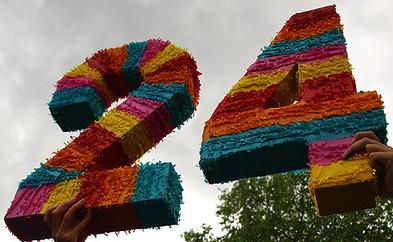
Math Teachers at Play #24

[Photo by internets_dairy.]

Welcome to the Math Teachers At Play blog carnival — which is not just for math teachers! If you like to learn new things and play around with ideas, you are sure to find something of interest. Let’s start the mathematical fun with an arithmetic card game in honor of our 24th edition and a few number puzzles:

Continue reading Math Teachers at Play #24

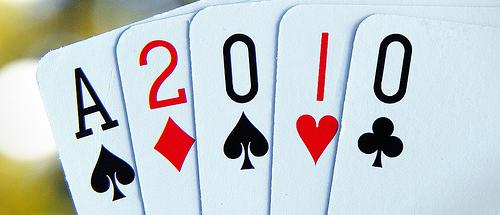
2010 Mathematics Game


[Photo by pfala.]

Did you know that playing games is one of the Top 10 Ways To Improve Your Brain Fitness? So slip into your workout clothes and pump up those mental muscles with the 2010 Mathematics Game!

Here are the rules:

Use the digits in the year 2010 to write mathematical expressions for the counting numbers 1 through 100.

  • All four digits must be used in each expression. You may not use any other numbers except 2, 0, 1, and 0.
  • You may use the arithmetic operations +, -, x, ÷, sqrt (square root), ^ (raise to a power), and ! (factorial). You may also use parentheses, brackets, or other grouping symbols.
  • You may use a decimal point to create numbers such as .1, .02, etc.
  • Multi-digit numbers such as 20 or 102 may be used, but preference is given to solutions that avoid them.

Bonus Rule
You may use the overhead-bar (vinculum), dots, or brackets to mark a repeating decimal.

[Note to teachers: This rule is not part of the Math Forum guidelines. It makes a significant difference in the number of possible solutions, however, and it should not be too difficult for high school students or advanced middle schoolers.]

Continue reading 2010 Mathematics Game

Cardstock Geometry Puzzle

While browsing the Kim Komando website for ideas I could use in my blogging class, I followed a rabbit trail through Kim’s video archive. I think we will try this in Math Club next semester:

If the embedded video doesn’t work on your computer, you can find the original here: Unbelievable Paper Transformer.

Update

Simon posted a template for the puzzle at his MathsClass blog.

Math Teachers at Play #20

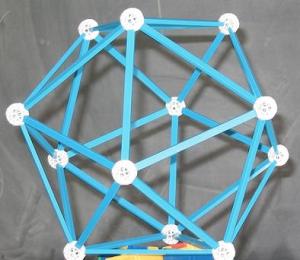
blue icosahedron, by shonk[Photo by shonk.]

Welcome to the Math Teachers At Play blog carnival — which is not just for math teachers! If you like to learn new things and play around with ideas, you are sure to find something of interest.

Let’s start the mathematical fun with a couple of puzzles in honor of our 20th edition: First, the shape to our right is an icosahedron, one of the Platonic solids. Each face is an equilateral triangle — can you count them? For more fun, make your own model.

Continue reading Math Teachers at Play #20

Math Teachers at Play #8

party-child-by-jaaron

[Photo by jaaron.]

Welcome to the Math Teachers At Play blog carnival — which is not just for math teachers! We accept entries from anyone who enjoys playing around with math, as long as the topic is relevant to students or teachers of preK-12th grade mathematics.

Some articles were submitted by their authors, other were drawn from the back-log in my blog reader, and I’ve spiced it all up with a few math jokes courtesy of the Mathematical humor collection of Andrej and Elena Cherkaev.

Let the mathematical fun begin…

Continue reading Math Teachers at Play #8